Kyoto was the capital of Japan for more than a thousand years, from 794 until the court moved to Tokyo in 1868, and the city still carries that history in its temples, shrines and gardens. Seventeen of them are listed together as a UNESCO World Heritage Site. The frames here were taken over two days in early January, when the light is low and clear, the maples are bare and the crowds are thinner than in spring or autumn. They move from the covered lane of Nishiki Market in the city centre to the Zen temple of Tenryū-ji and the bamboo grove in Arashiyama on the western edge, then east to the orange torii tunnels climbing Mount Inari, and finally to a five-storey pagoda lit gold against a violet winter dusk. Together they show a city of roughly 1.46 million people that is as much a place of markets and commuters as of monuments.

The Temple Below the Hills
Kyoto’s first-ranked Zen temple, its pond garden and a stern face at the kitchen door.
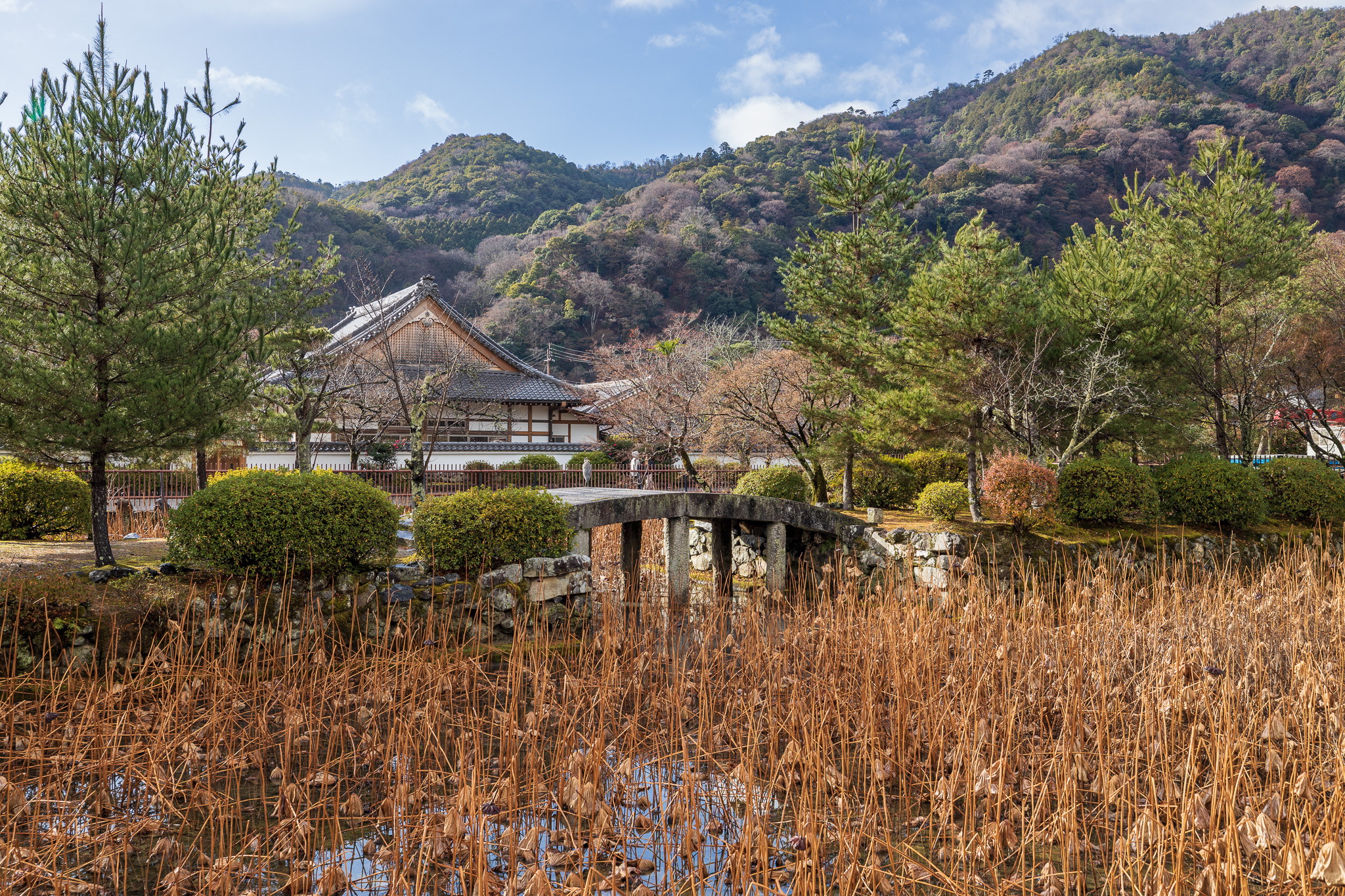
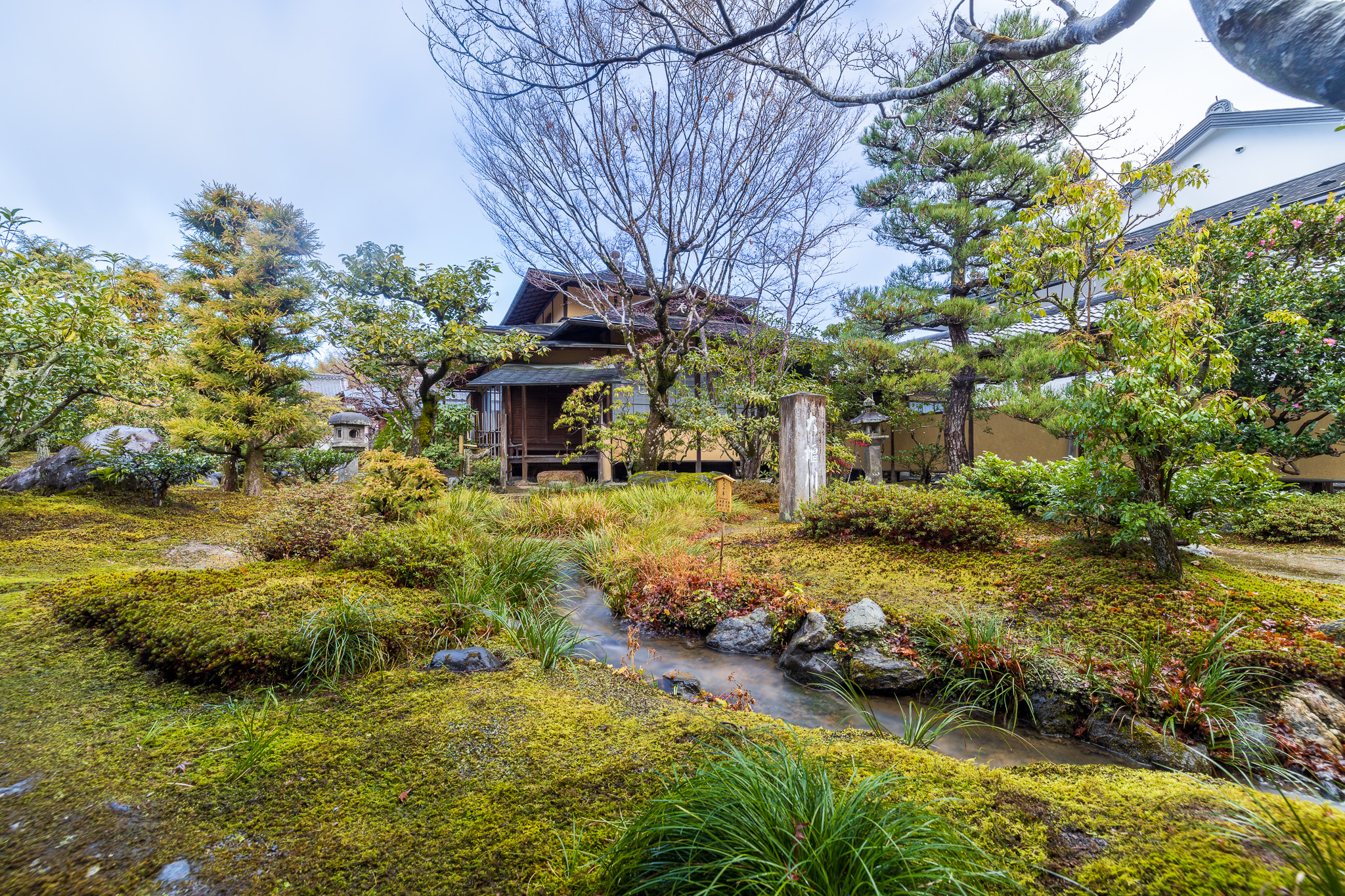
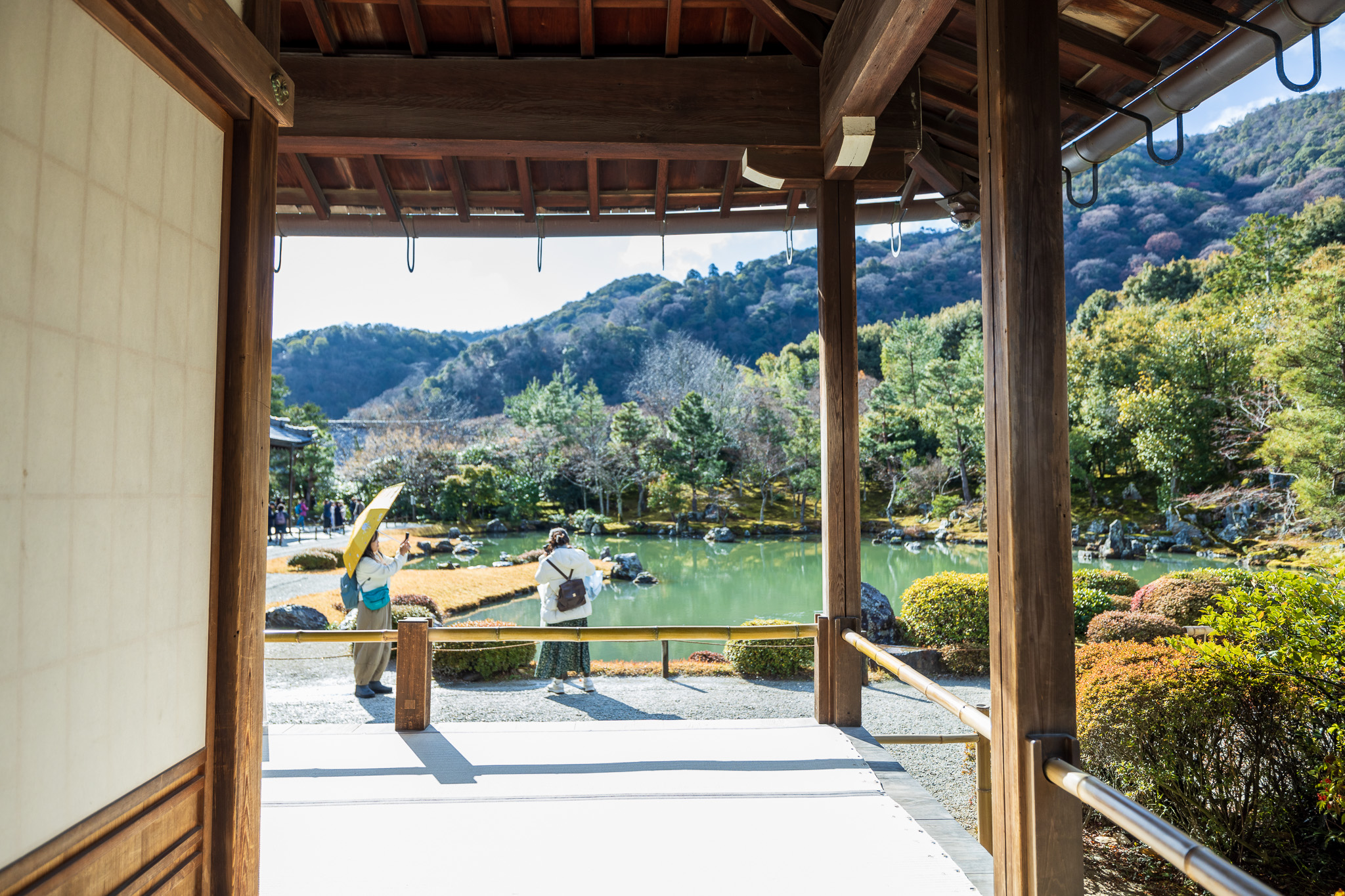
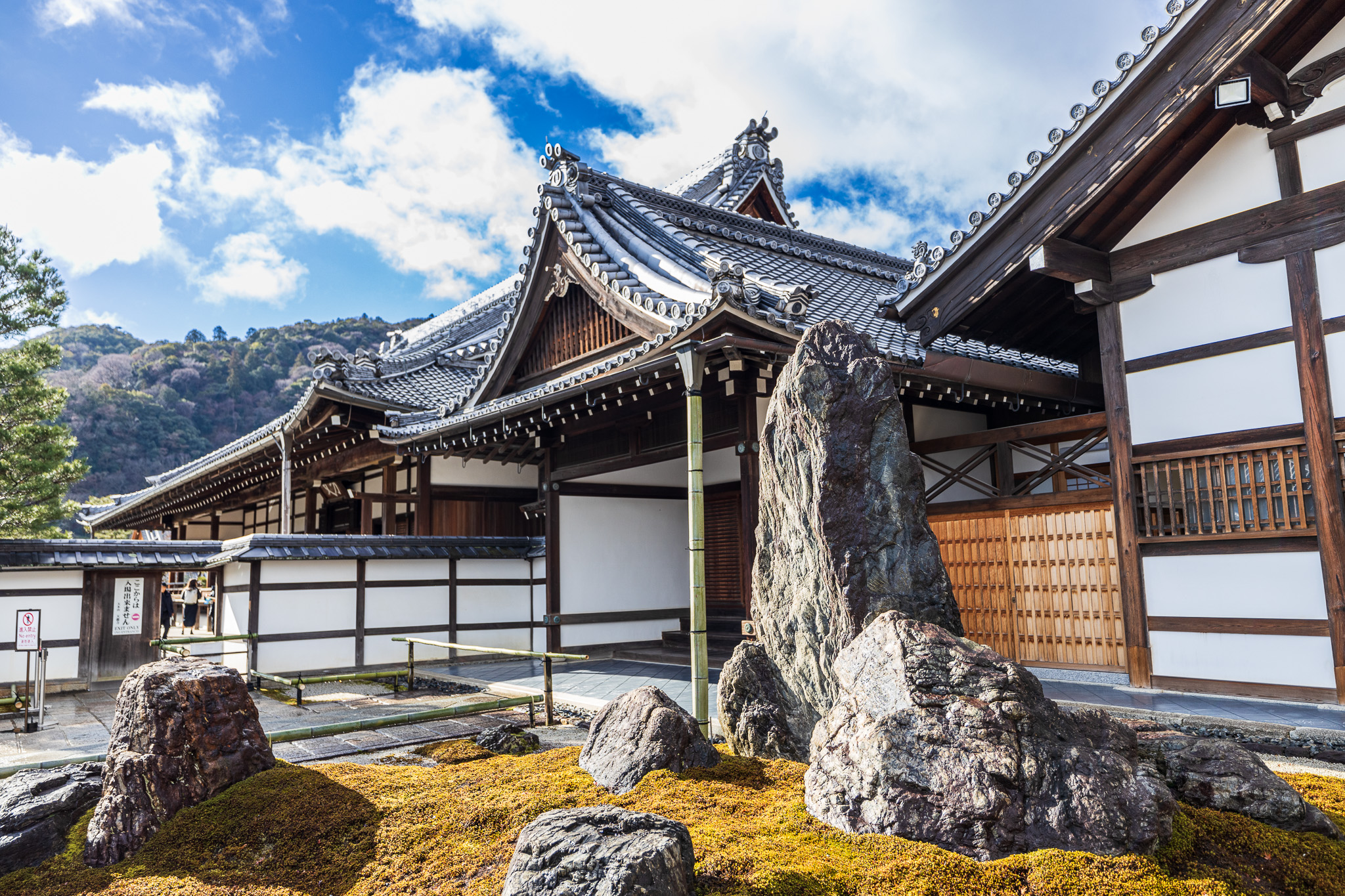
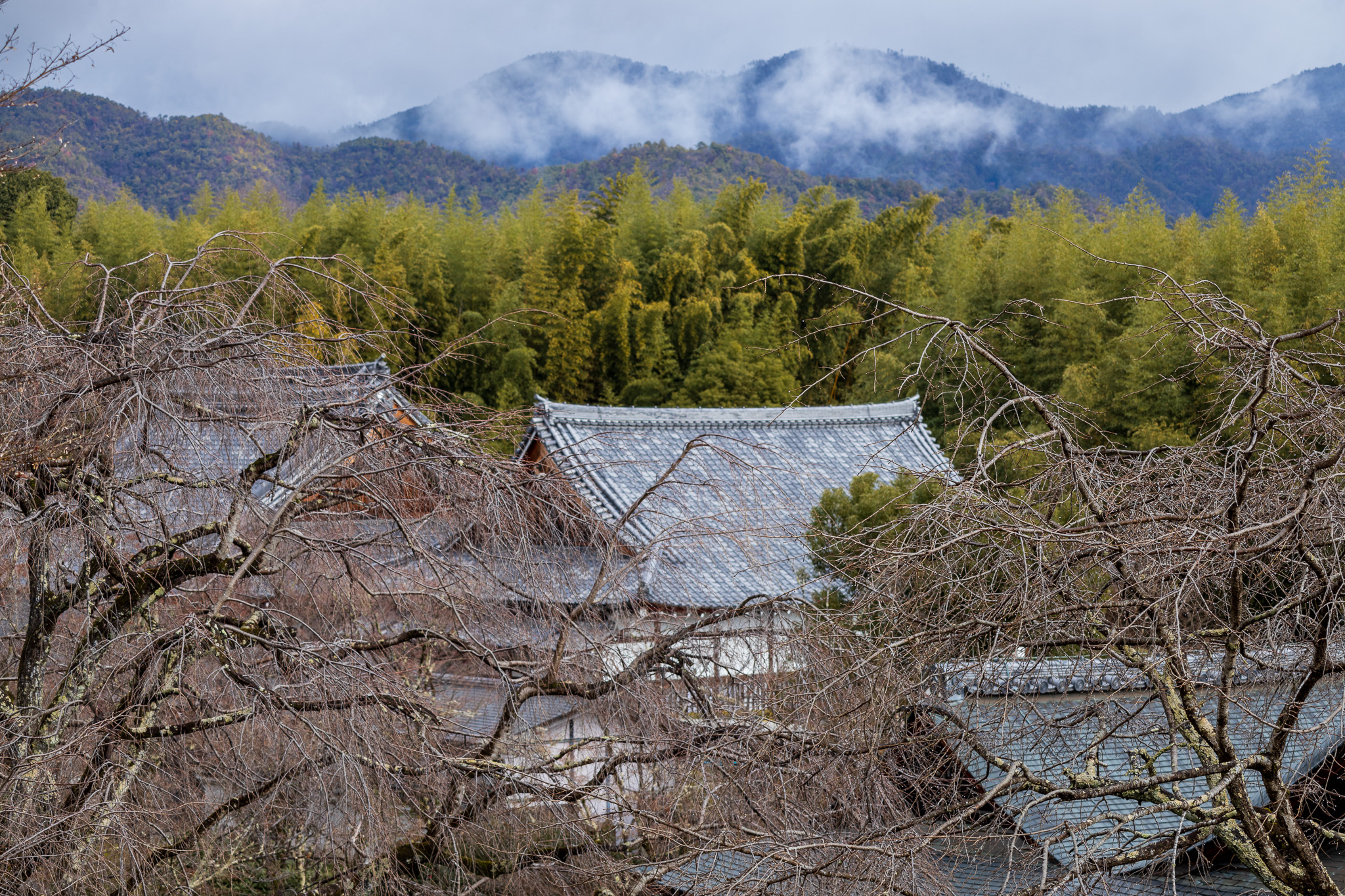
Tenryū-ji sits at the foot of the Arashiyama hills, where the city gives way to forest. It was founded in 1339 by the shogun Ashikaga Takauji in memory of Emperor Go-Daigo, with the Zen master Musō Soseki as its first abbot, and it ranks first among the Five Mountains, the great Zen temples of Kyoto. The buildings burned repeatedly, most recently in 1815, so the halls seen here are mostly from the Meiji period onwards. The garden around the Sōgenchi pond is older and keeps the shape Musō Soseki gave it: a sheet of water, stones set in groups, and the wooded slopes of Arashiyama borrowed as a backdrop.
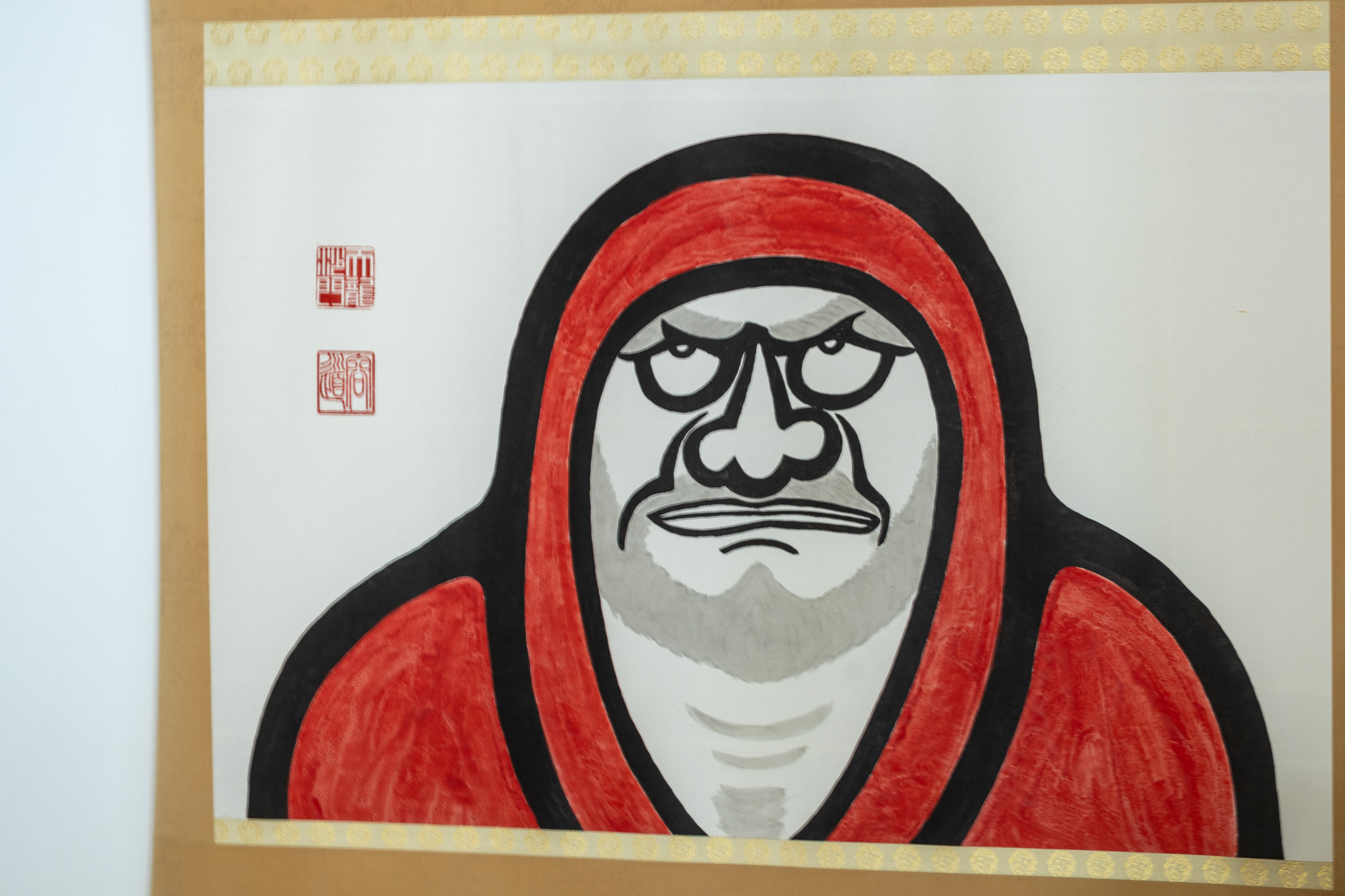
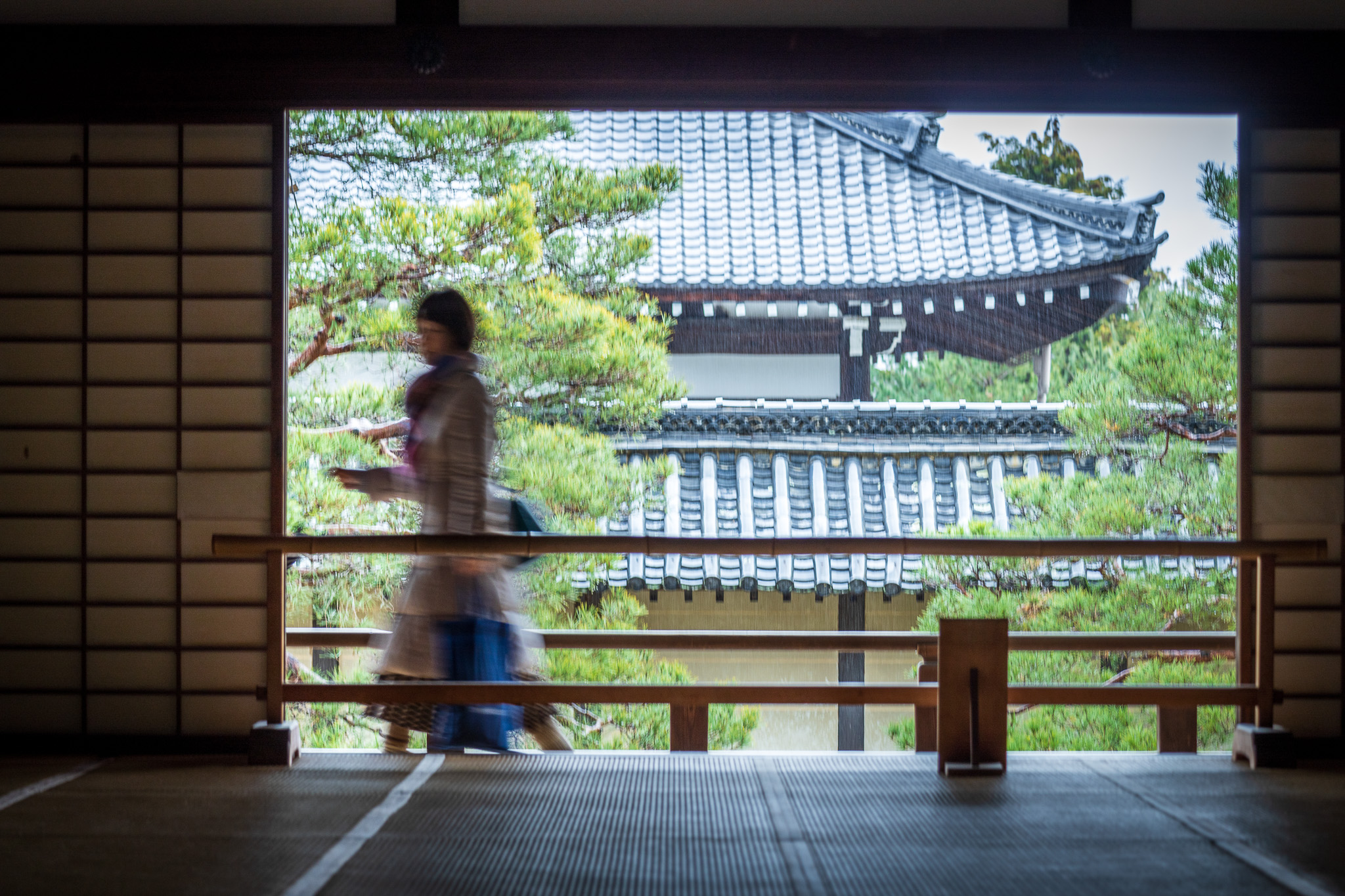
In January the garden is subdued. Moss and pines hold their green while the maples stand bare, and the reeds in front of the temple roofs have dried to the colour of straw. The frames follow a visitor through the halls: the painting of Daruma, founder of Zen, that greets people at the entrance; an open screen framing the curved tiles of the next roof; the veranda where visitors sit to look across the pond to the hills; and a view back over the roofs to the bamboo and mist above.
Green Light in the Bamboo
A short walk from the temple, the stems close overhead and the light turns green.
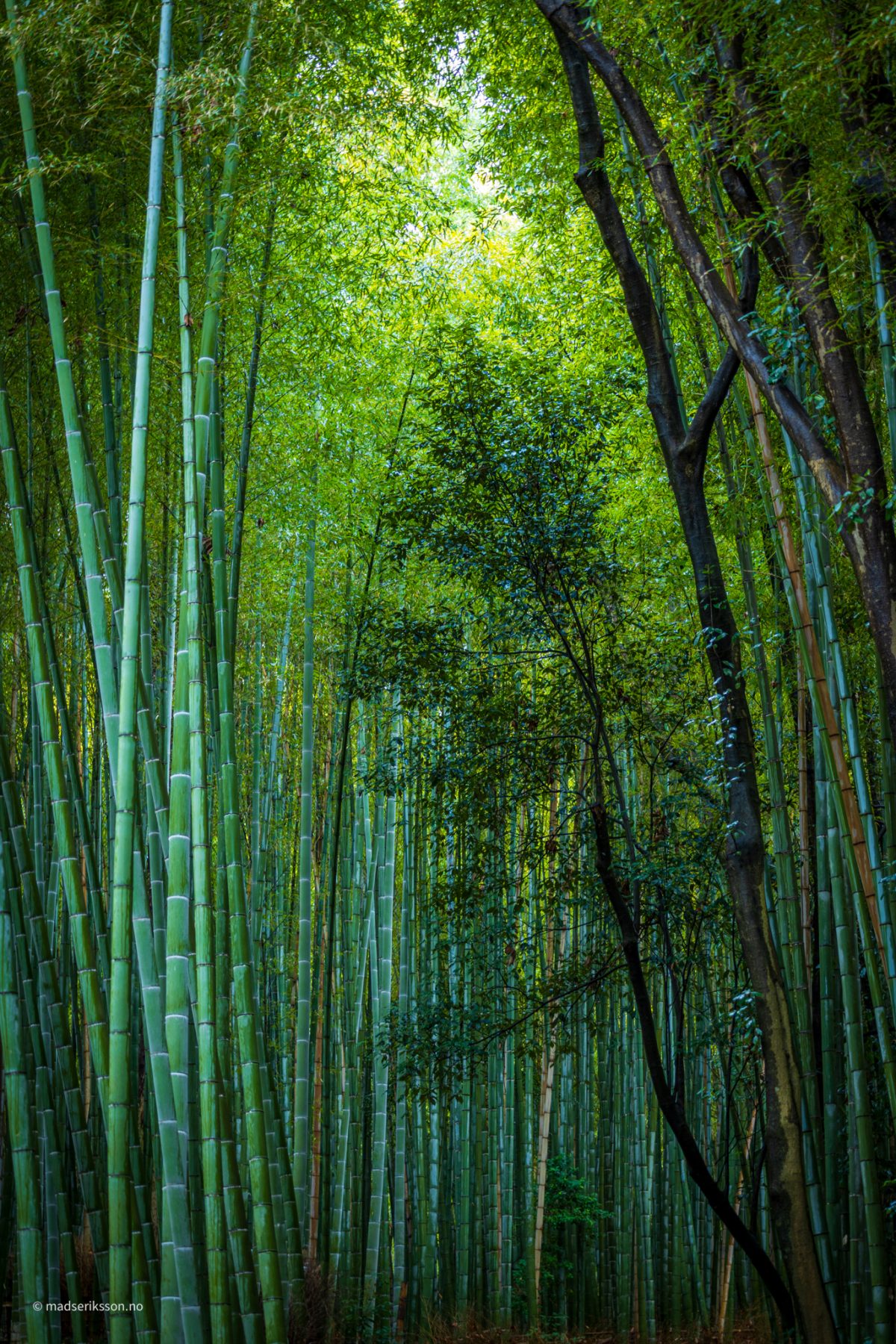
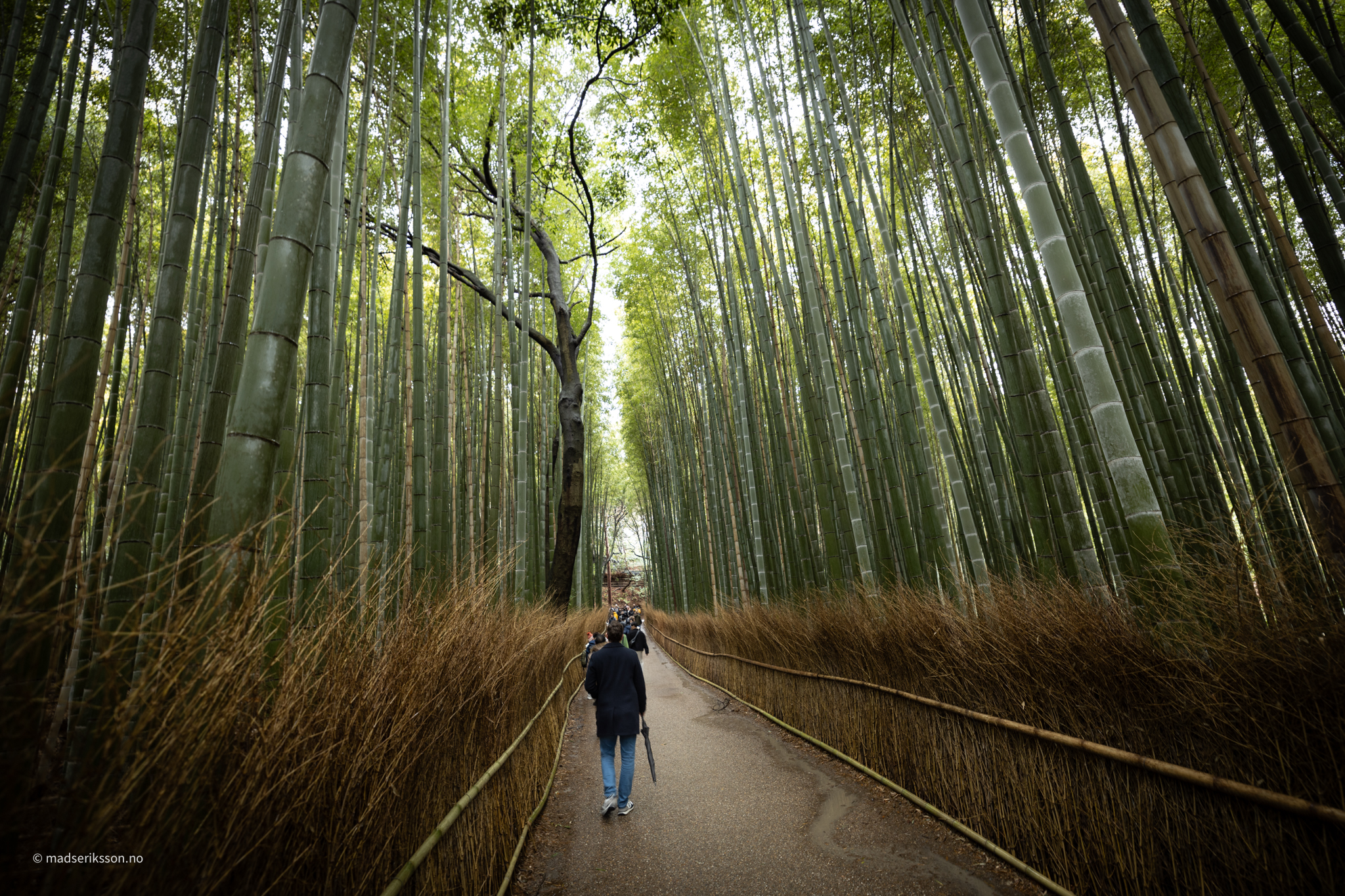
The bamboo grove begins just beyond the north gate of Tenryū-ji and runs for a few hundred metres towards the Ōkōchi Sansō villa. The stems are mōsō bamboo, which can reach 20 m or more, and they grow so close that the path between them is in shade for most of the day. Looking straight up, as in the first frame, the canopy becomes a tangle of thin green leaves against a soft grey sky, and the trunks fall away in parallel lines. It is one of the most photographed places in Kyoto, and on most days the lane is full; the stillness in the picture comes from the frame, not the crowd.
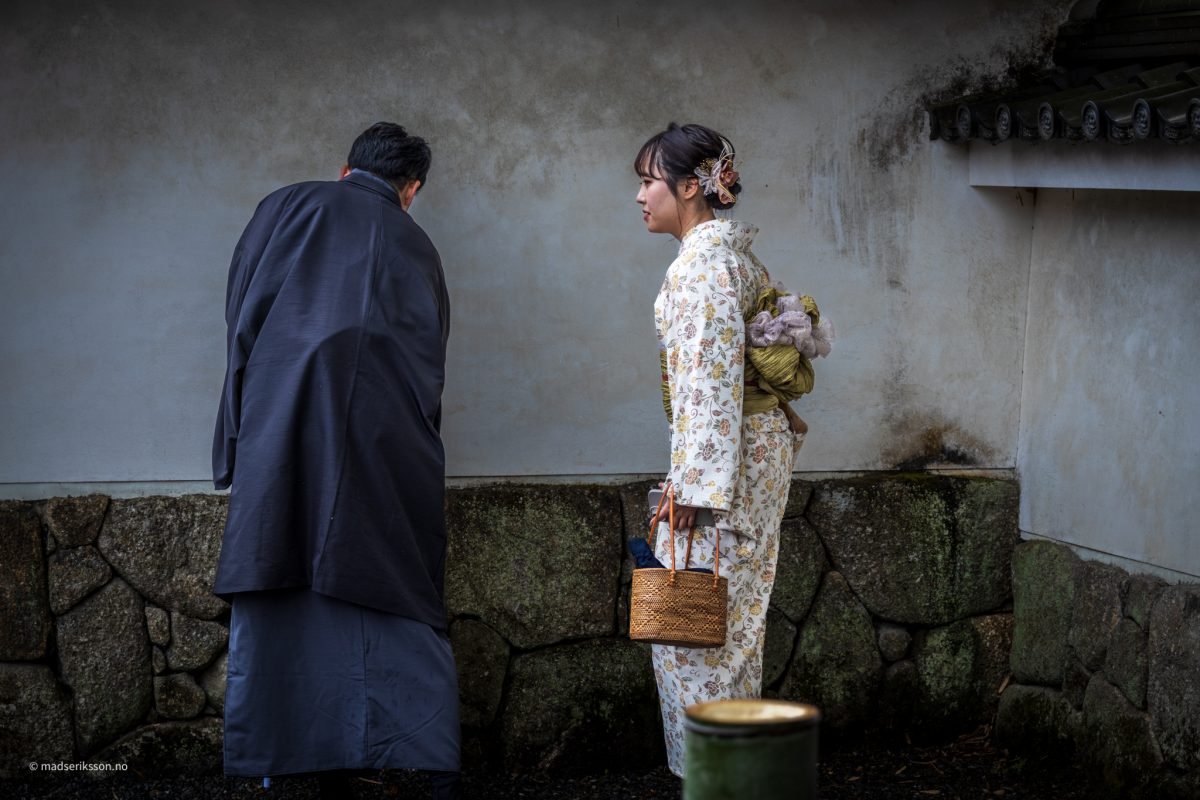
Arashiyama is also one of the districts where visitors hire kimono for the day. The second frame catches a couple in rented dress at a whitewashed wall on a stone base, the woman in a pale patterned kimono with a woven basket bag, the man in dark grey. They stand in the flat winter light that makes the fabrics read clearly against the plaster.
The Covered Lane
Four hundred metres of fish, pickles, tempura and lanterns under a coloured roof.
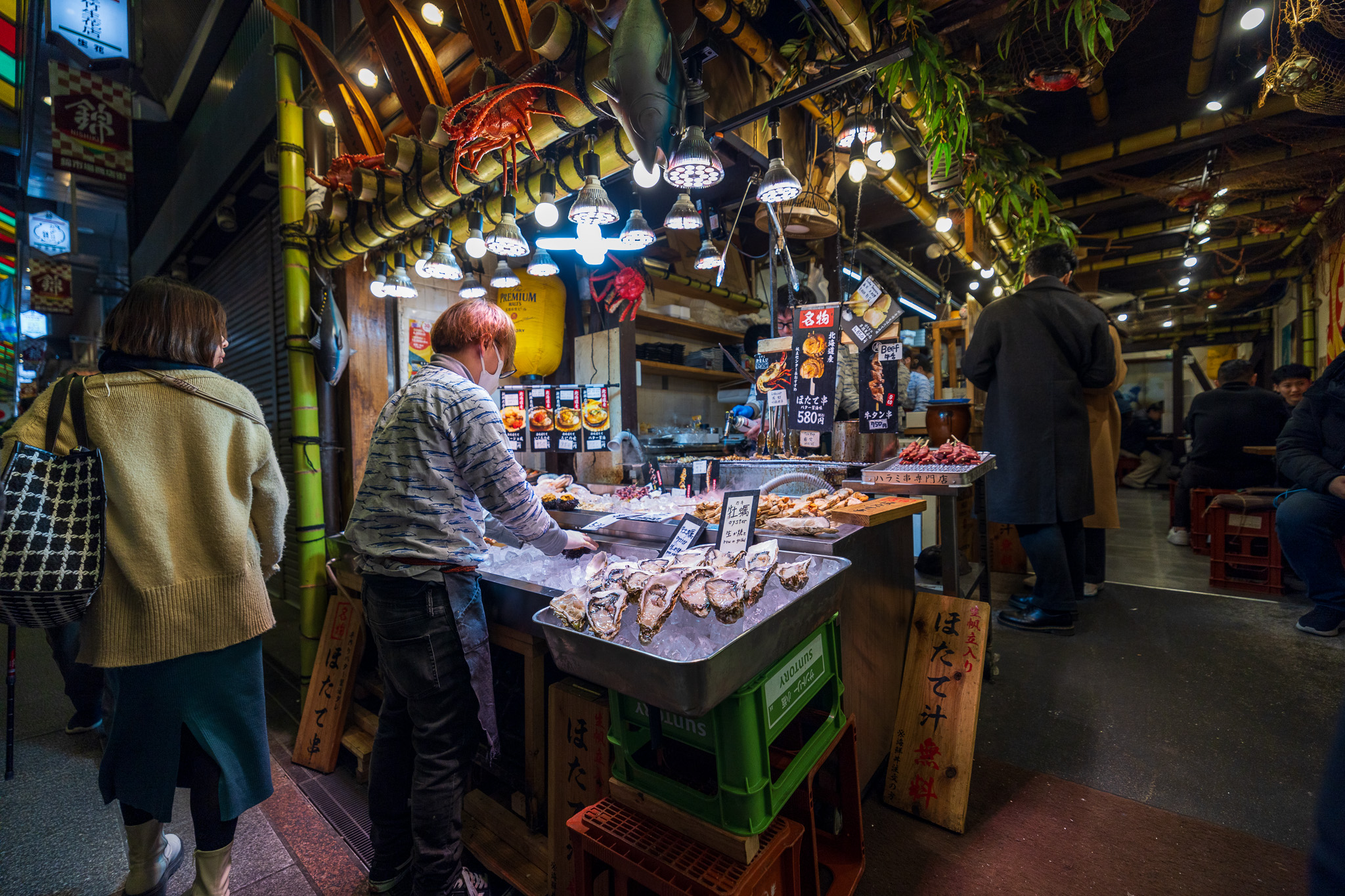
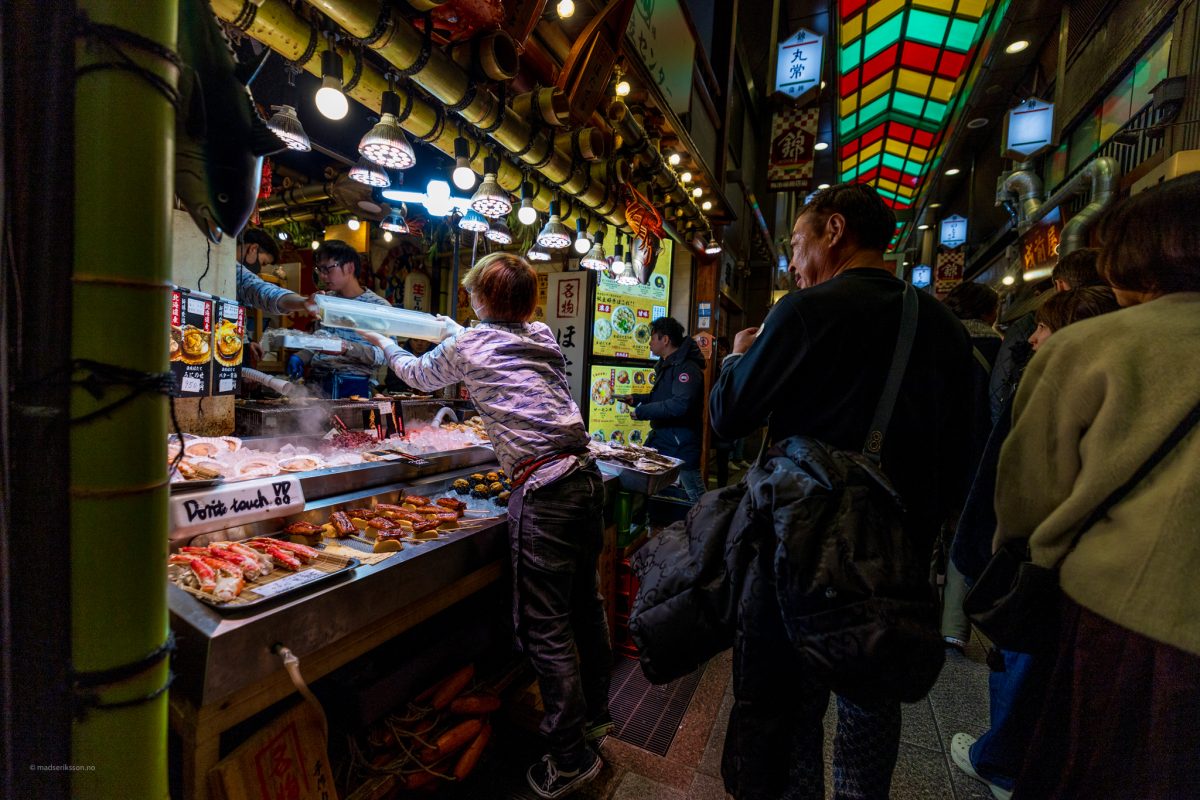
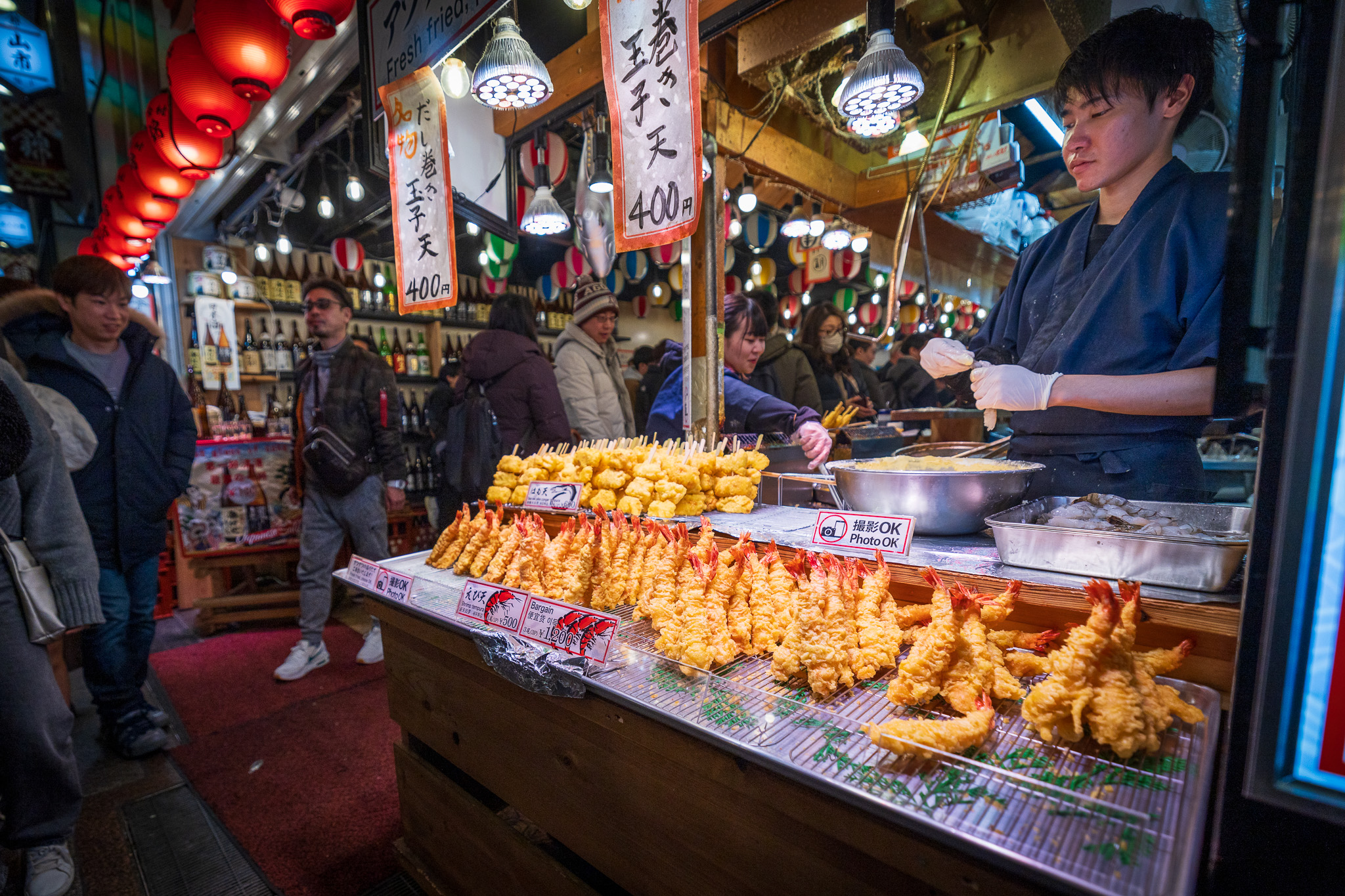
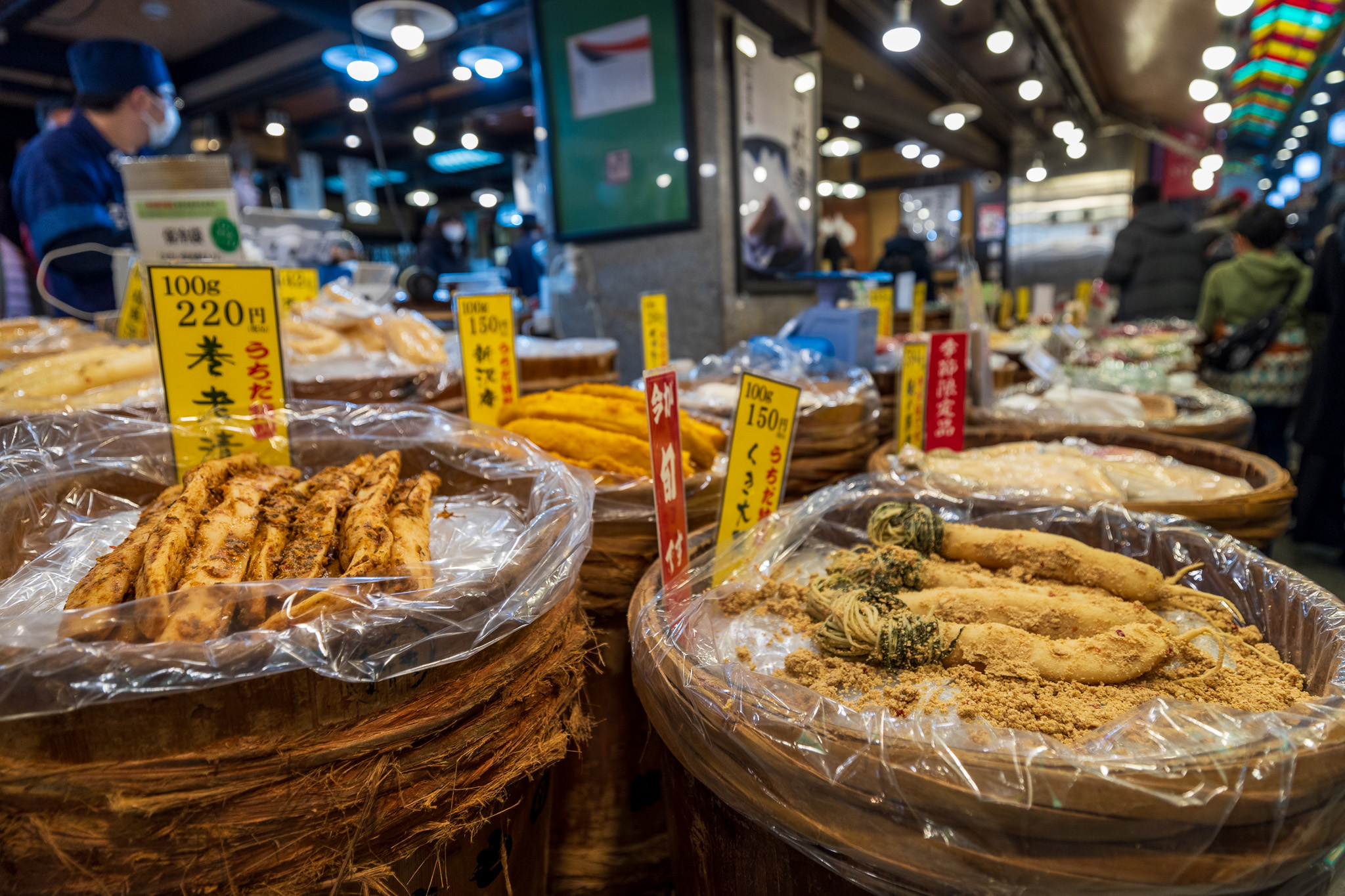
Nishiki Market is a single narrow lane running east to west for about 400 m along Nishikikōji Street, one block north of Shijō. Fish has been sold here since the eighth century, and the market received its official licence from the shogunate in 1615, which is why it is known as Kyoto’s kitchen. Today roughly 130 shops line the arcade: fishmongers with oysters and crab on ice, stalls of pickled vegetables and dried goods in wooden tubs, knife makers, tea merchants and counters frying tempura and skewers to eat standing up.
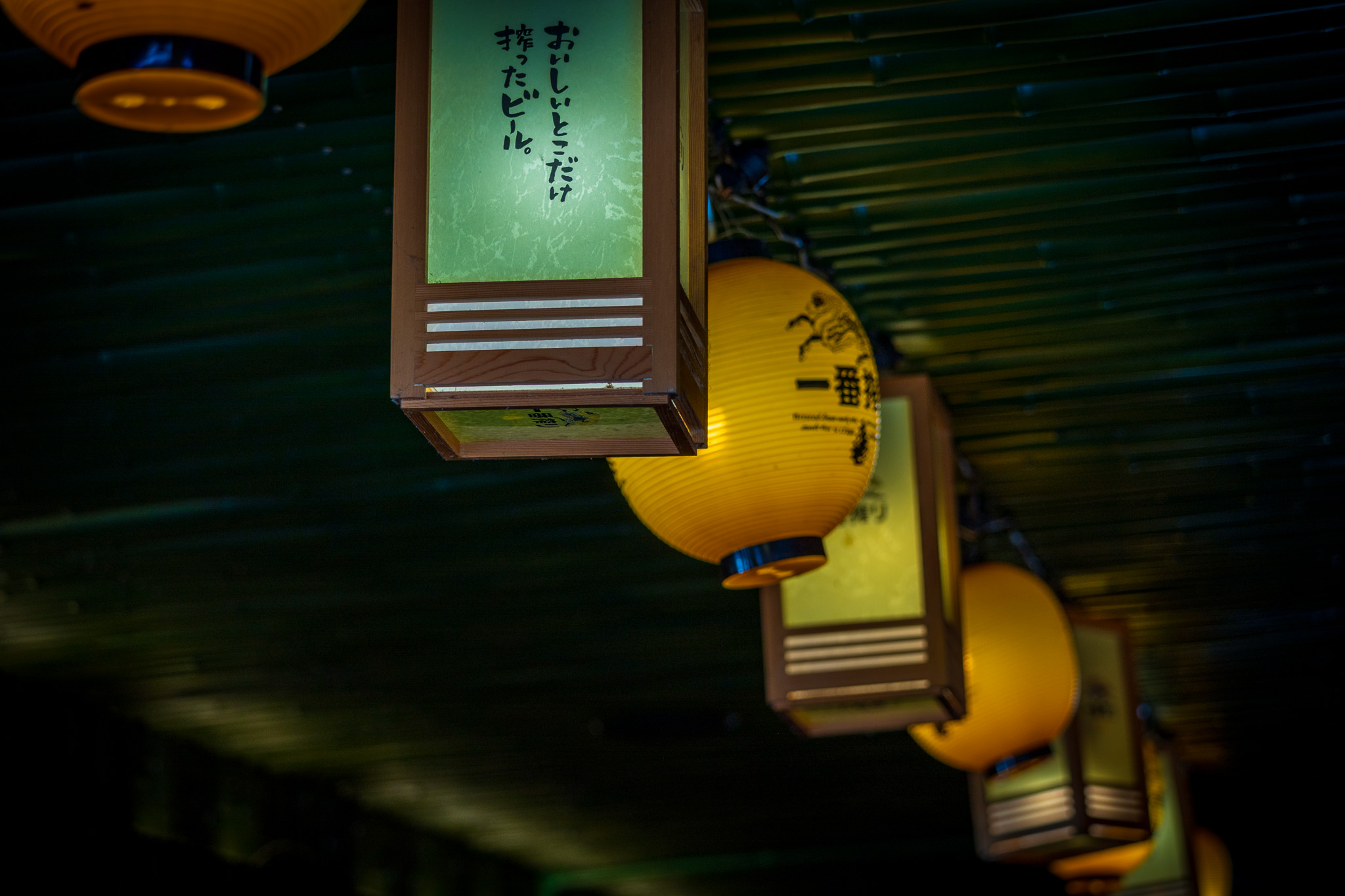
The frames are taken in the middle of the afternoon, when the lane is at its busiest. Overhead, the glass roof is tinted in panels of red, yellow and green, and that colour drops onto the shoppers and the wet counters below. Paper lanterns in yellow and green hang from the beams above one stall, lit in the dim. One vendor in a cap works a fryer behind a tray of shrimp and skewers; another leans over a fish counter in the crush. The pickles stall, with its price cards at 220 and 500 yen, is the quietest picture of the five.
Ten Thousand Gates
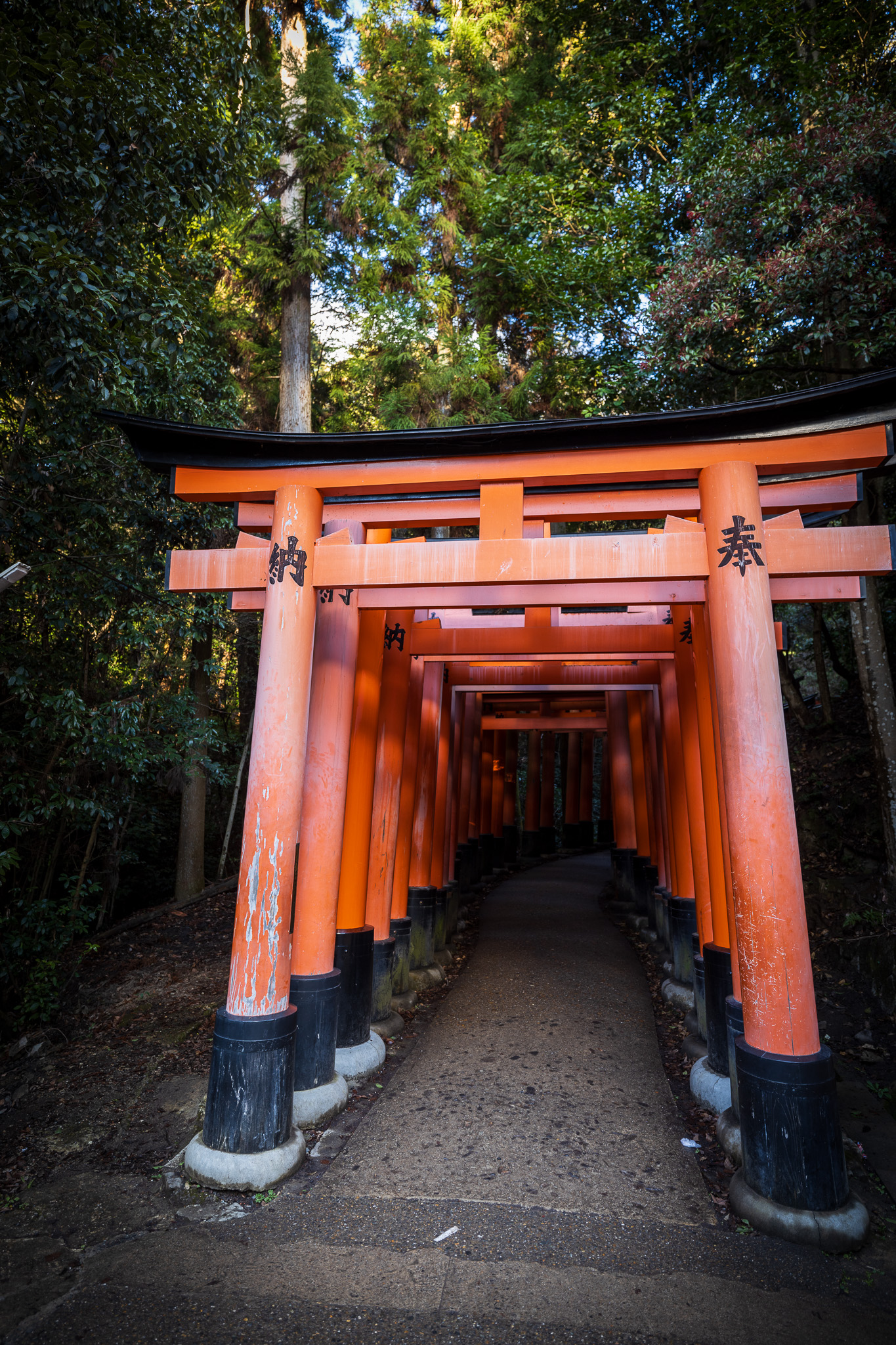
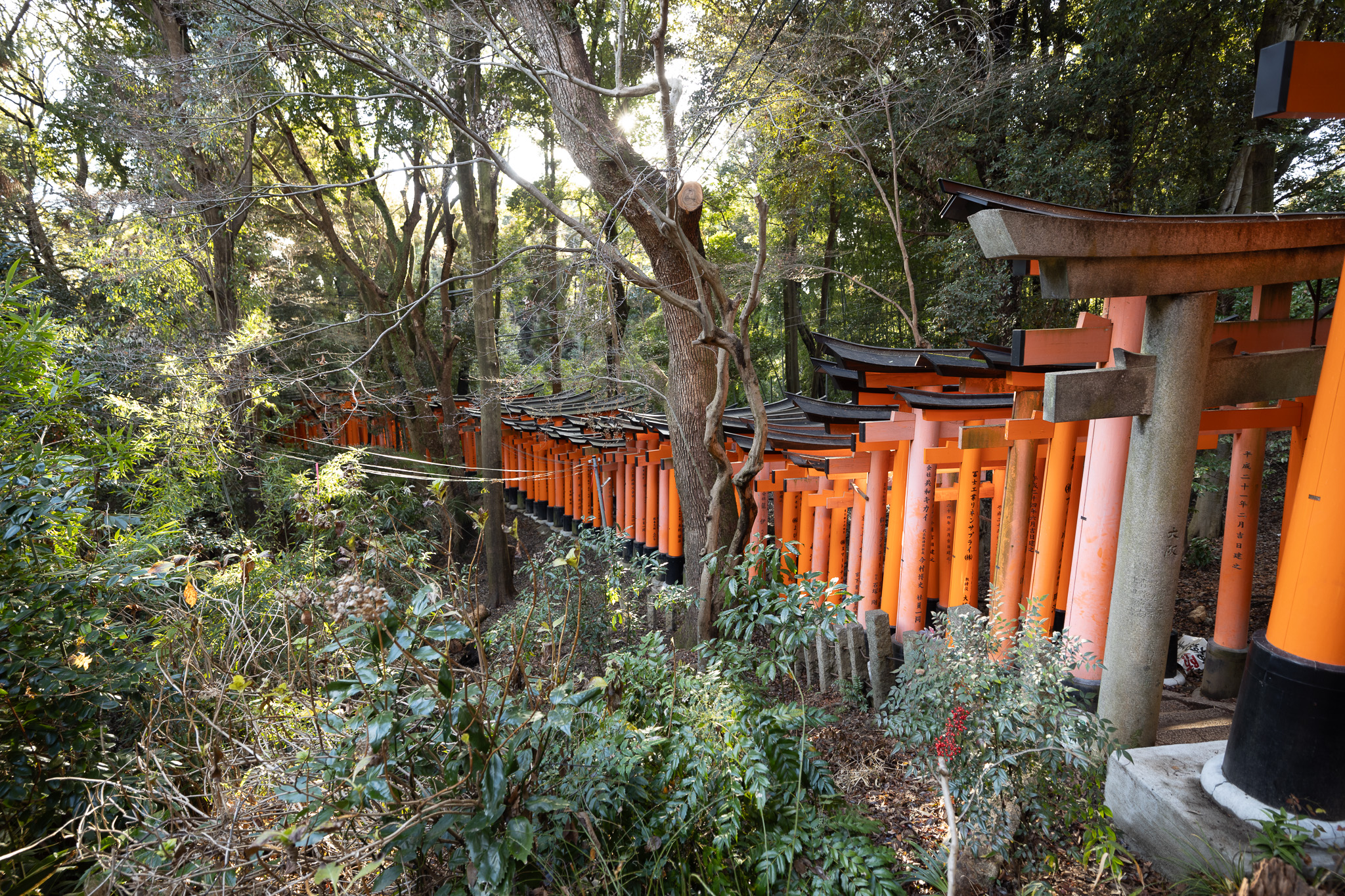
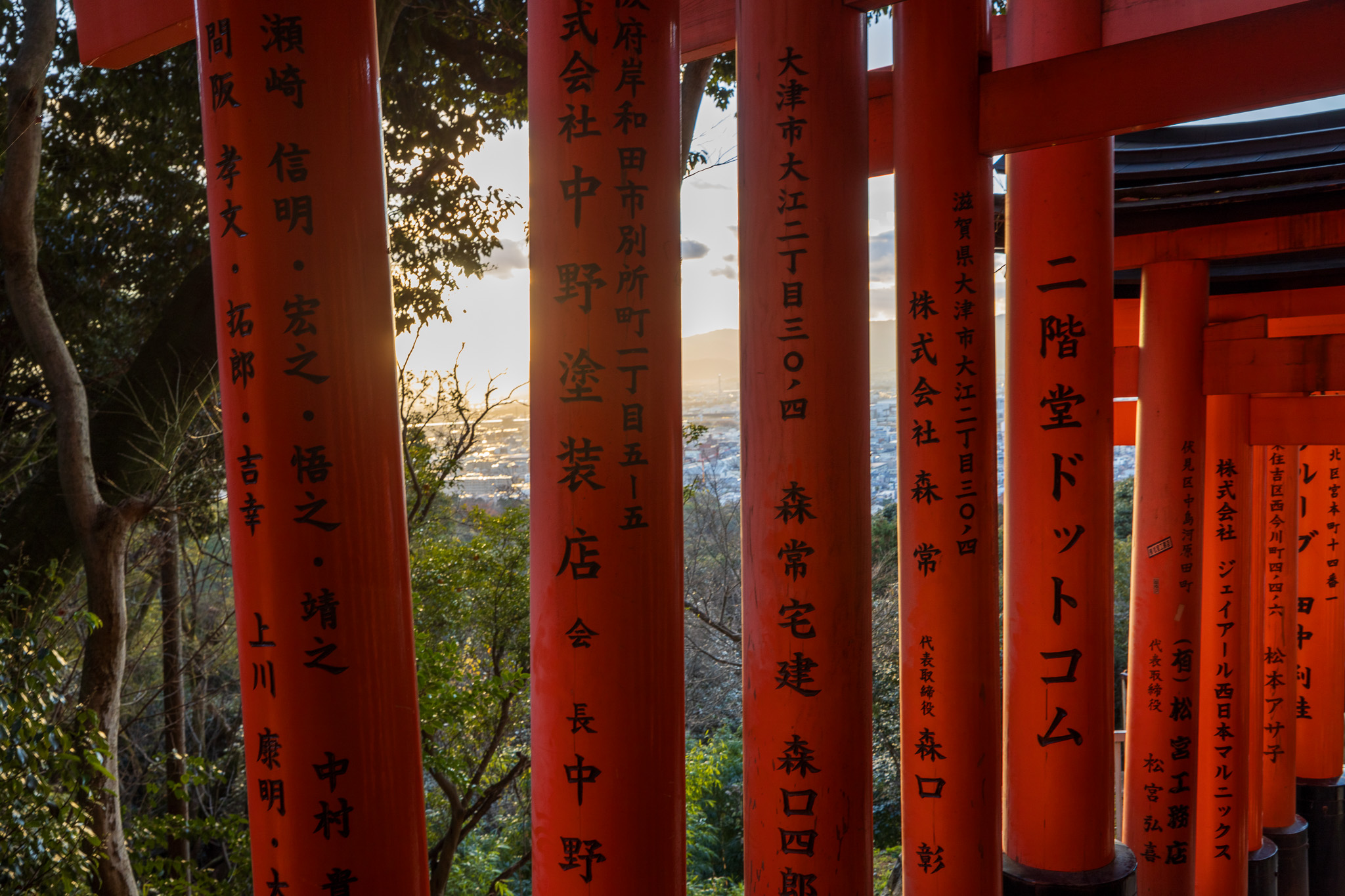
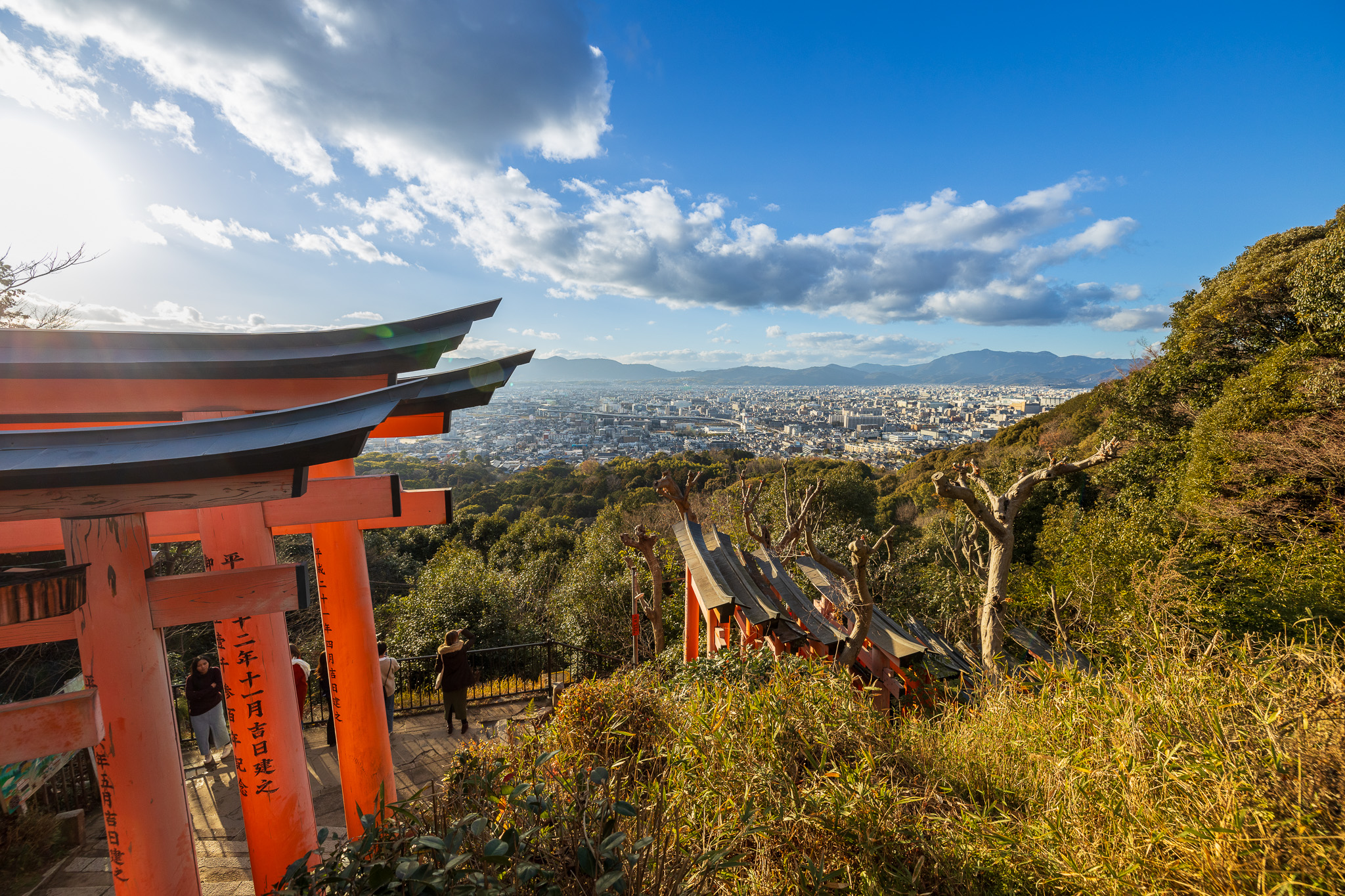
Orange torii climb a wooded hill in the south-east of the city, and the view opens over Kyoto near the top.
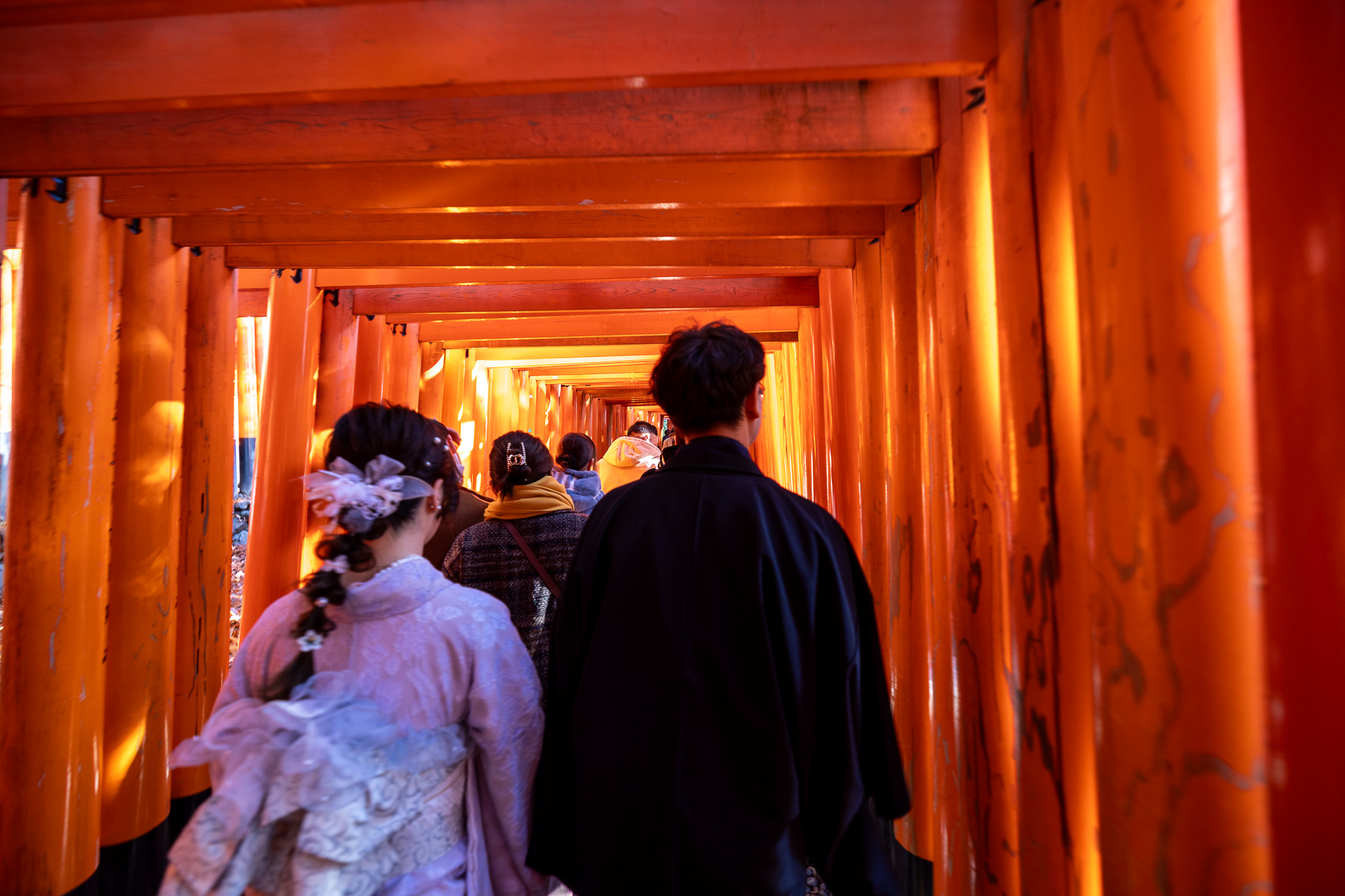
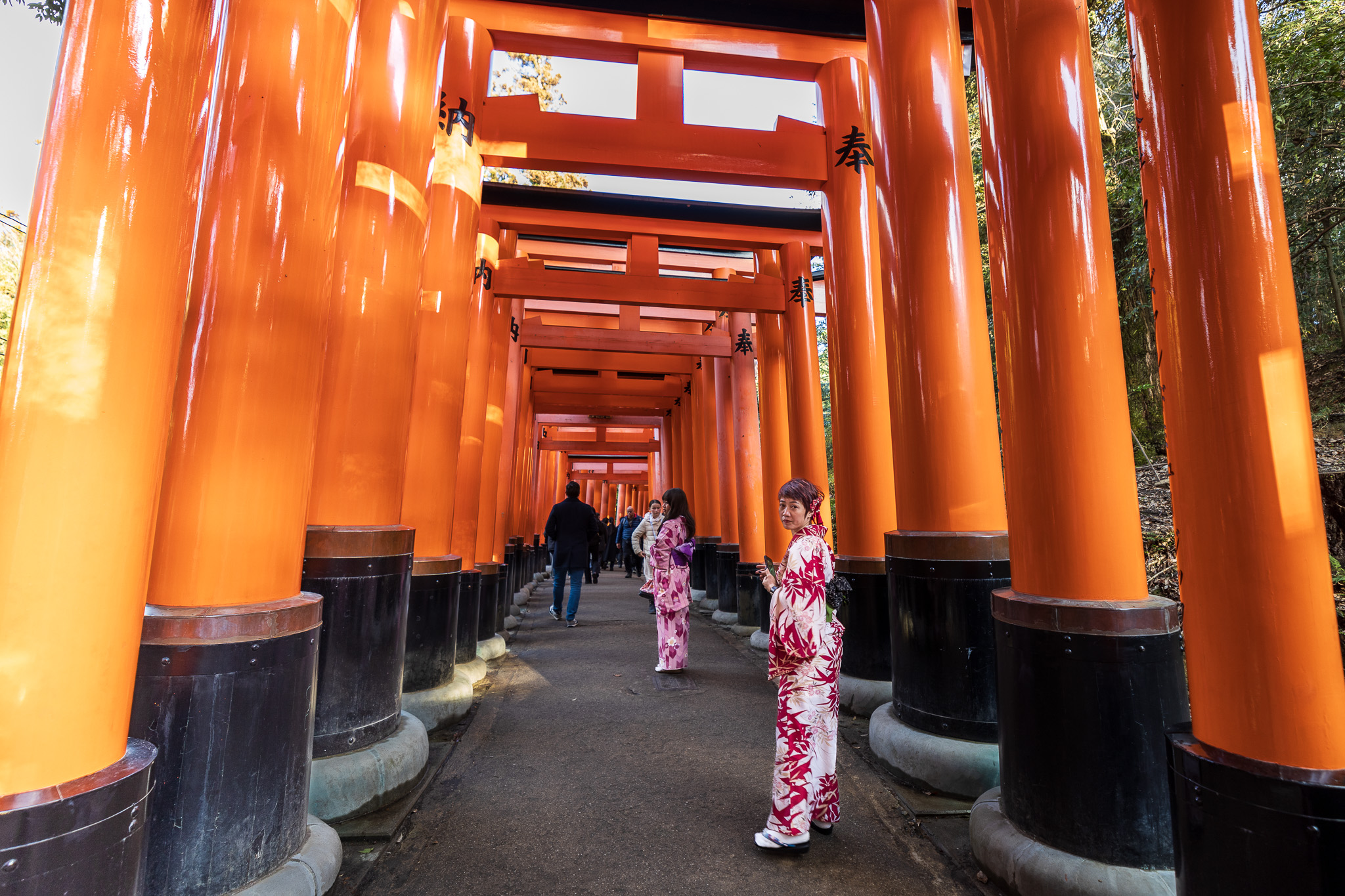
Fushimi Inari Taisha is the head shrine of Inari, the deity of rice, sake and prosperity, and traditionally dates from 711. What draws most visitors is not the main hall but the trails behind it, which climb about 4 km over the 233 m Mount Inari through some 10,000 torii gates. Each gate is a donation from a business or family hoping for success, and the donor’s name and the date are painted in black characters on the uprights, as the close frame shows. The lowest and densest stretch, the Senbon Torii, splits into two parallel tunnels that run so tight the daylight comes through in slits.
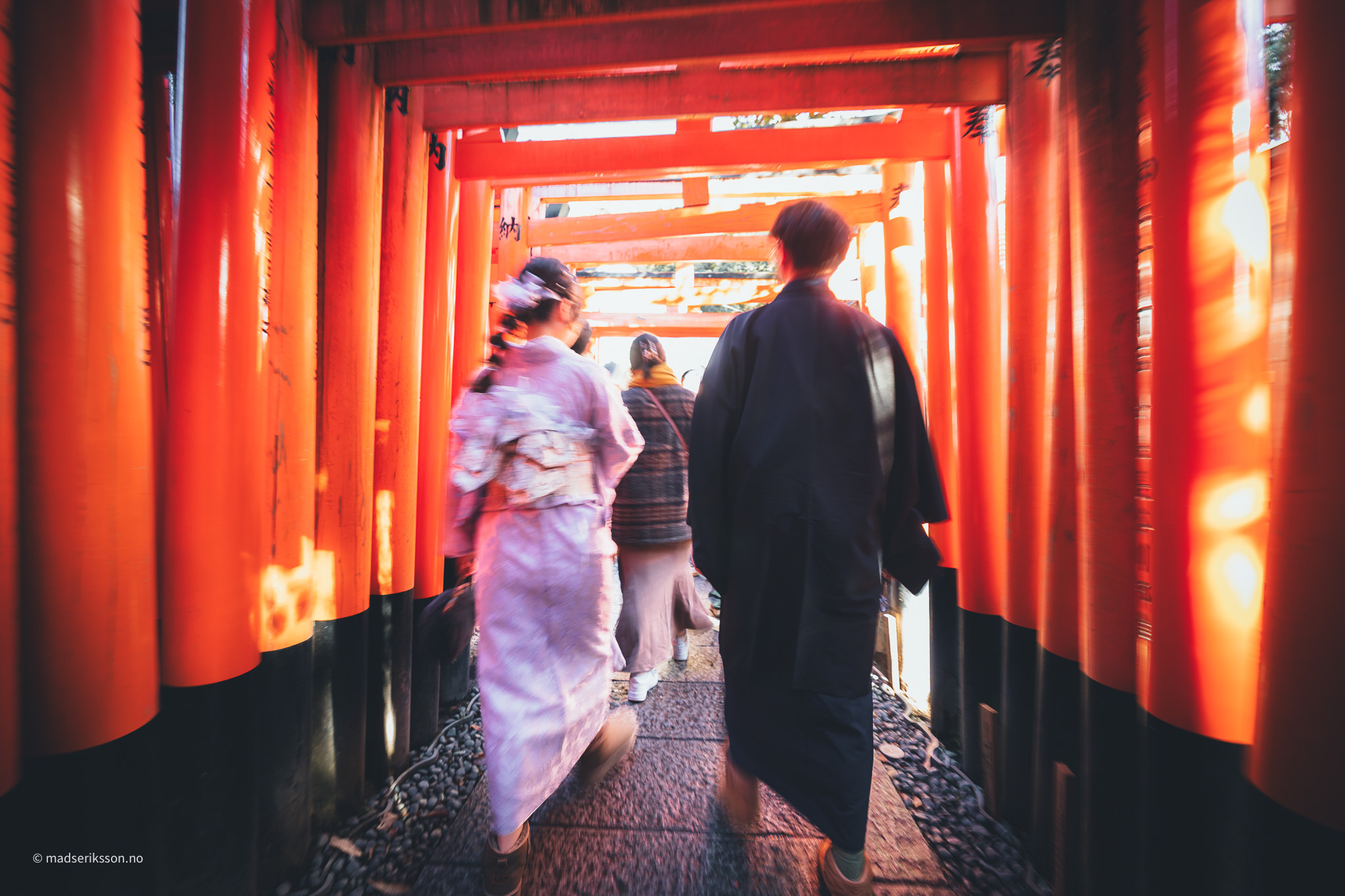
Taken in the late afternoon of a clear January day, the frames follow the climb: visitors in kimono passing into the glow of the tunnel; the twin entrances seen from outside, their pillars footed in black; rows of gates winding away through the cedar and bamboo; and, near the top, the moment the trees part and the city basin lies spread out in the low sun below the gates.
Gold Against Violet
Floodlights pick out the tiers of a five-storey pagoda as the winter sky drains of colour.
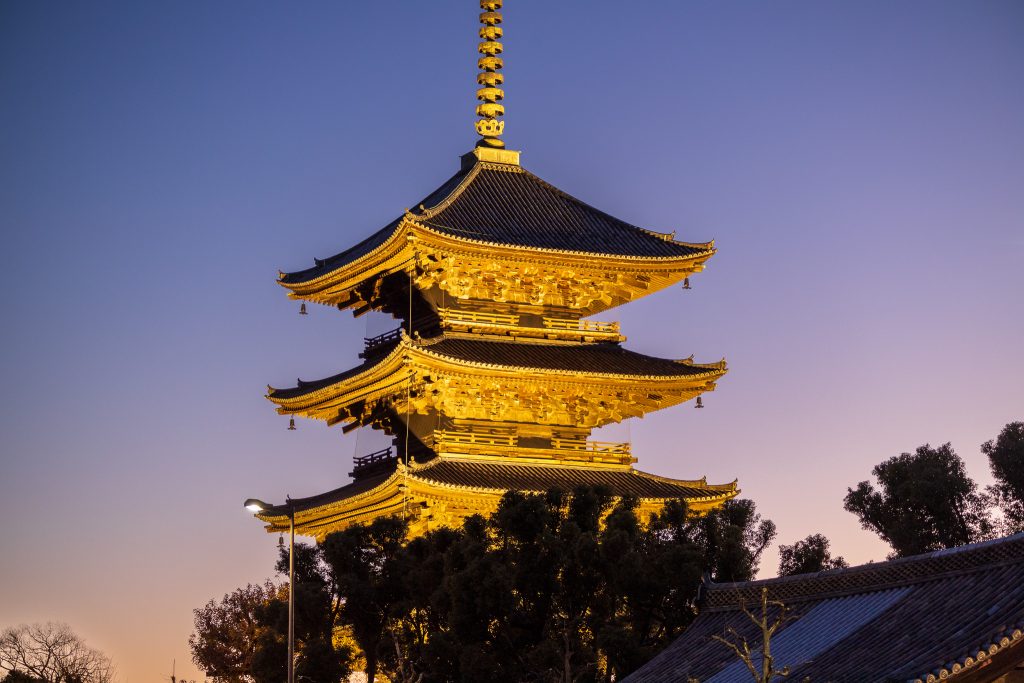
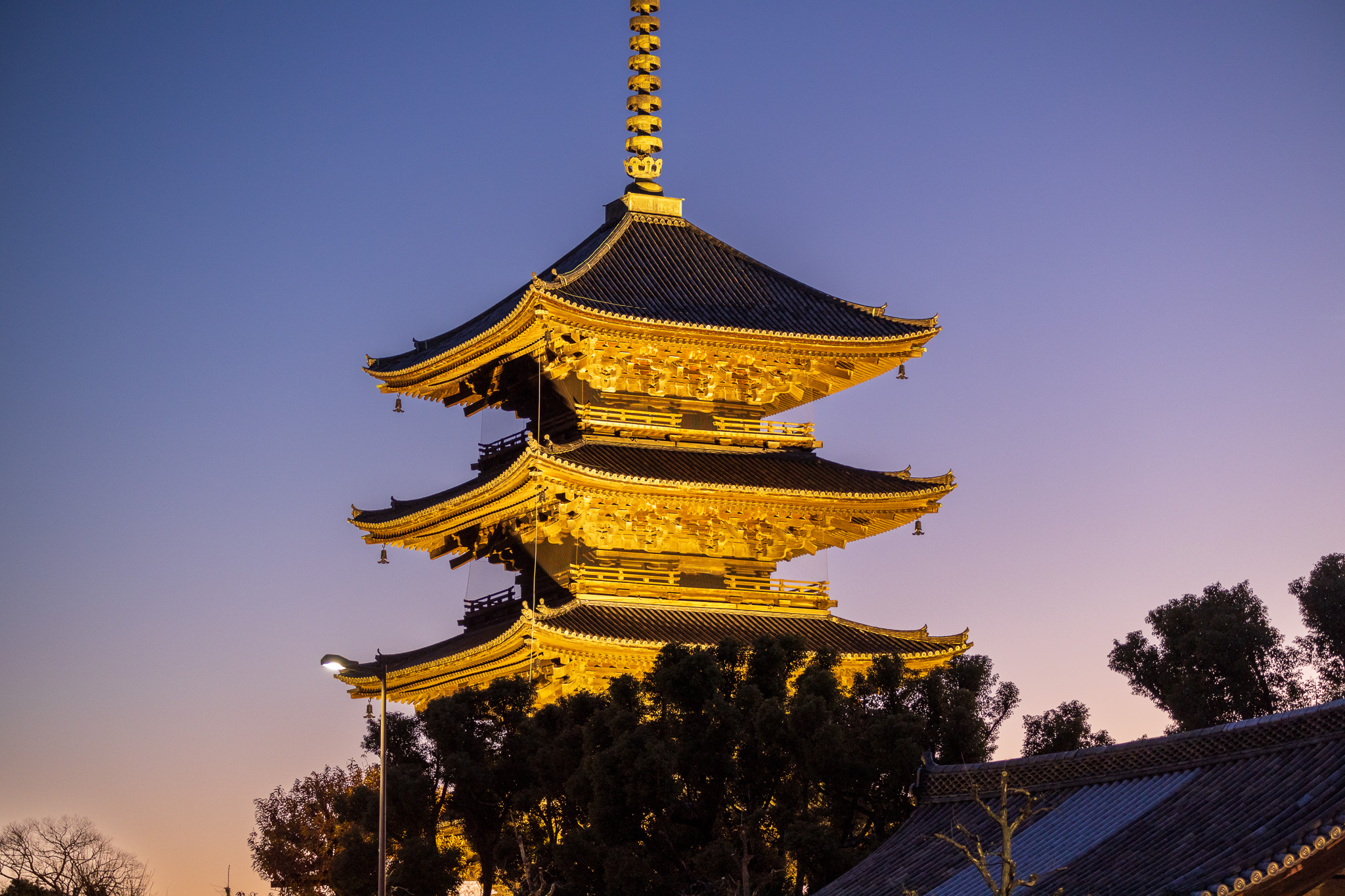
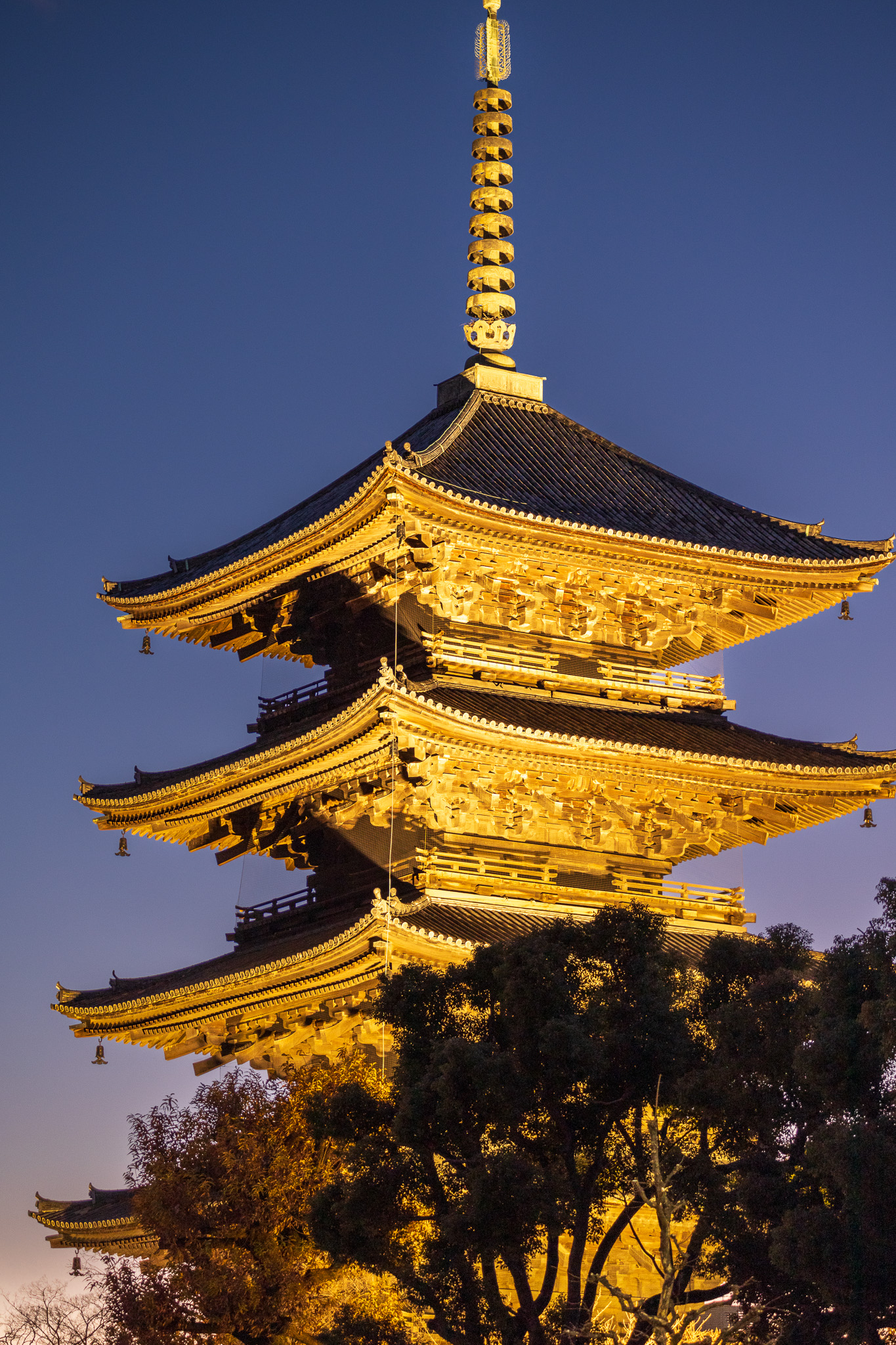
Kyoto has several five-storey pagodas, and the tallest of them, at Tō-ji near the station, is also the tallest wooden tower in Japan at 54.8 m. It was rebuilt for the fifth time in 1643 and is lit at night, so it is a landmark even for people only passing through on the Shinkansen. The pagoda in these two frames is seen from below and across a screen of dark pine, with the eaves of each tier catching the floodlight and the bronze finial climbing into the sky.
Both pictures were taken within two minutes of each other a little before 18:00 on 4 January, roughly twenty minutes after the Kyoto sunset. In that short window the lit timber reads as gold while the sky still holds a gradient from orange at the horizon to deep violet overhead; a few minutes later the sky goes black and the balance is lost. The horizontal frame gives the pagoda its setting among the trees; the vertical one isolates the tower and the finial.
«Kyoto in January is a city of low light and long shadows. The maples are bare, the moss is still green, and the orange of the torii burns harder against the winter woods than it does in summer. The market is loud and warm, the temple garden quiet and cold, and at dusk a lit pagoda stands over the rooftops as it has for centuries. Twenty-one frames from two days, one city, four very different kinds of light.»
More in the same area
 CitiesHiking Mount Inari — Fushimi Inari’s Full Loop
 CitiesKyoto: A Timeless Journey Through Japan’s Cultural Heart
TravelTenryū-ji — Arashiyama’s Zen Temple and Japan’s Oldest Surviving Garden
Food and DrinksNishiki Market — Kyoto’s Kitchen
 ForrestsDiscover the Enchantment of Arashiyama Bamboo Grove
 CitiesHiroshima and Miyajima: A preserved ruin and a shrine on the tideline