Seoul has been a capital since 1394, when the new Joseon dynasty moved its court to a basin ringed by mountains on the Han River, and it is now a city of some 9.4 million people with a metropolitan region of more than 25 million. The old centre north of the river still holds the palaces, the city gates and the hanok lanes of Bukchon; south of the river, Gangnam and Songpa are the Seoul of towers, screens and the 555 m Lotte World Tower. These thirty-eight frames were taken in midwinter, when the Han freezes in sheets, the sky is a hard clear blue by day and the nights are long enough that most of the city is seen lit. They move from the throne hall of Changdeokgung to the aluminium curves of Dongdaemun Design Plaza, from the steaming stalls of Gwangjang Market to the gate of Sungnyemun in a swirl of headlights, and finally up to the river seen from above at night and at dawn.

Six Centuries in One District
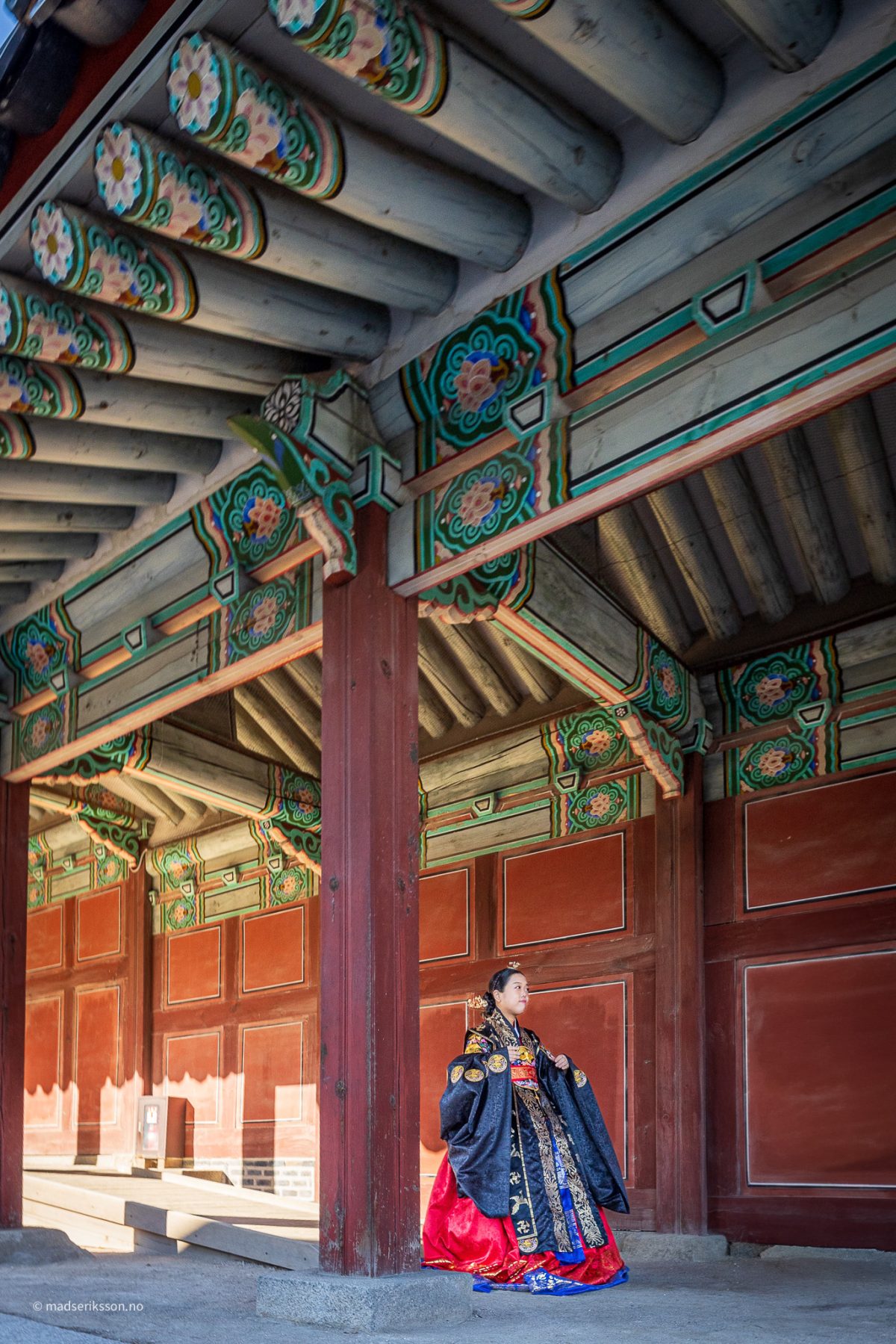
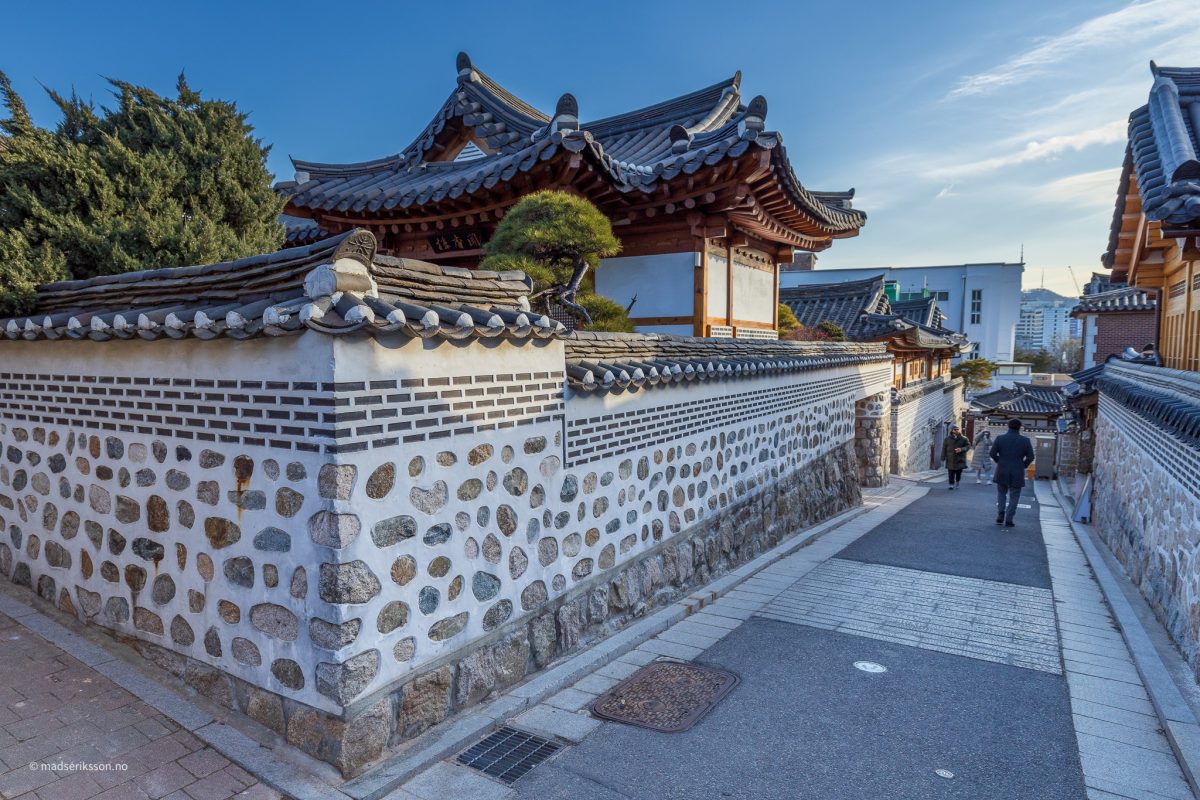
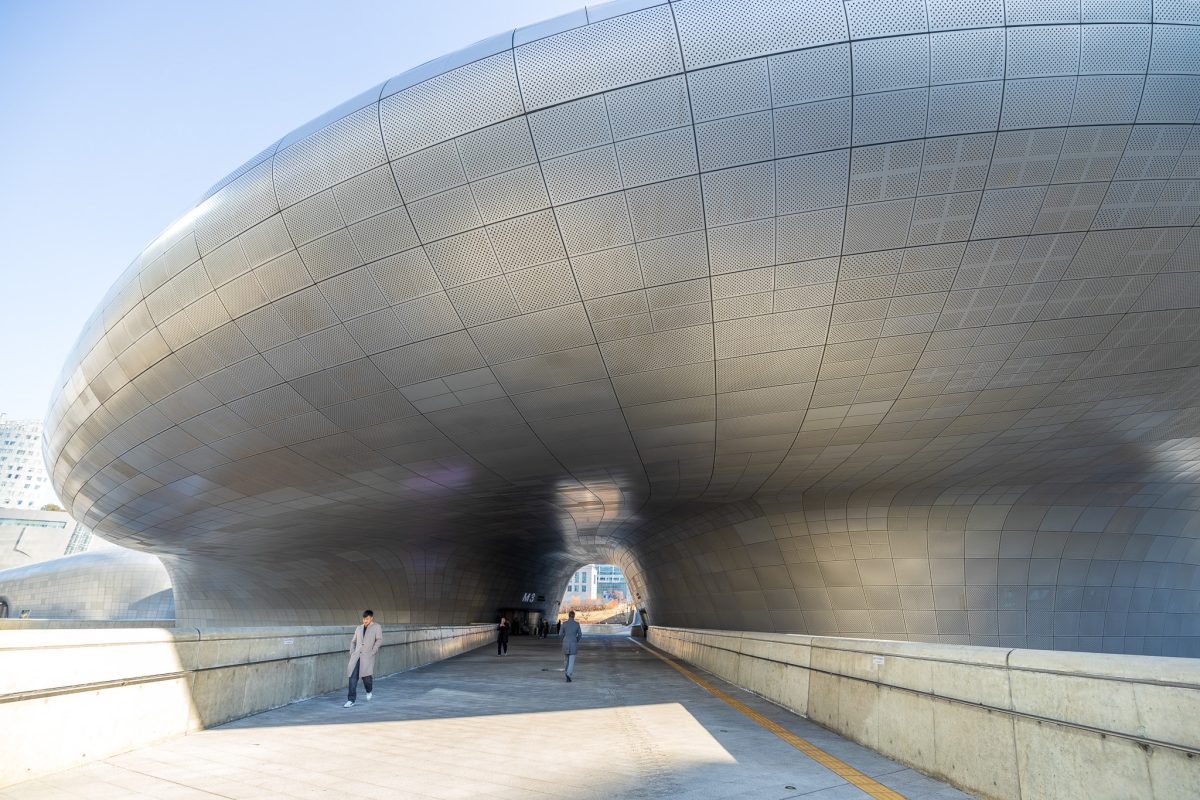
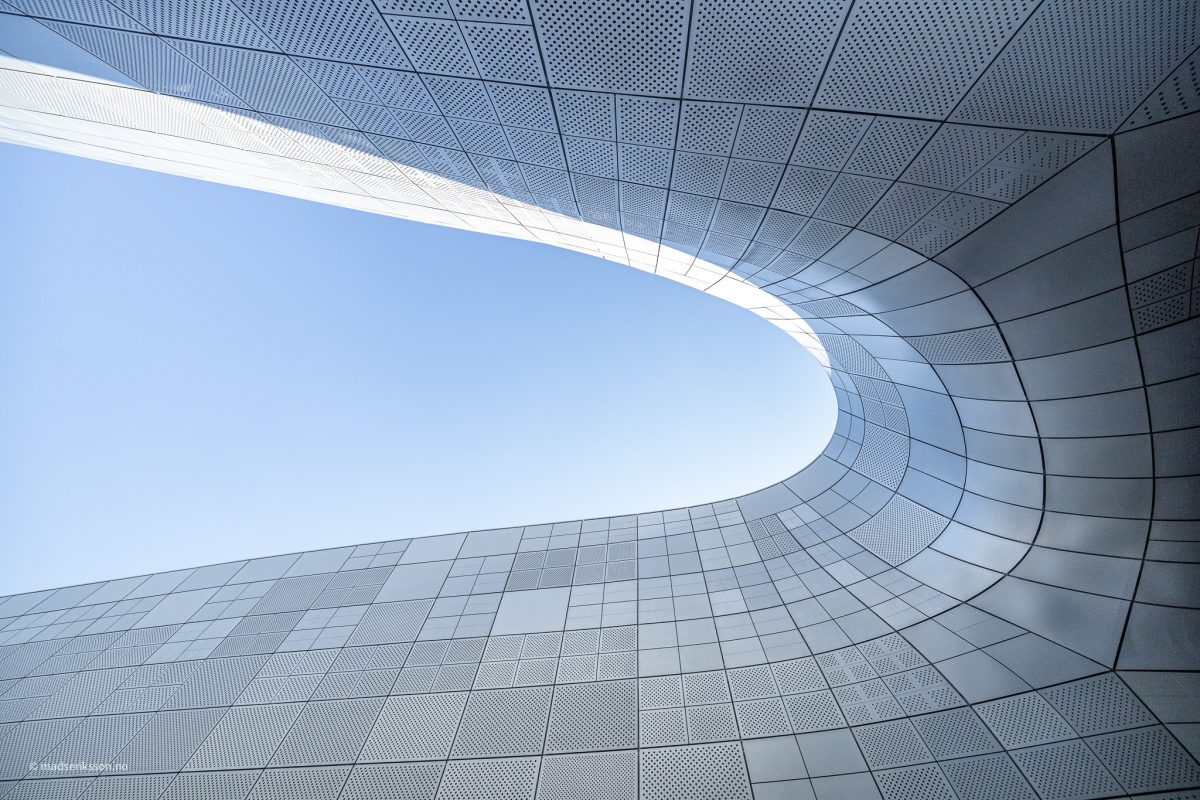
A Joseon throne hall, a lane of hanok and the aluminium curves of Zaha Hadid’s plaza, all within a few kilometres.
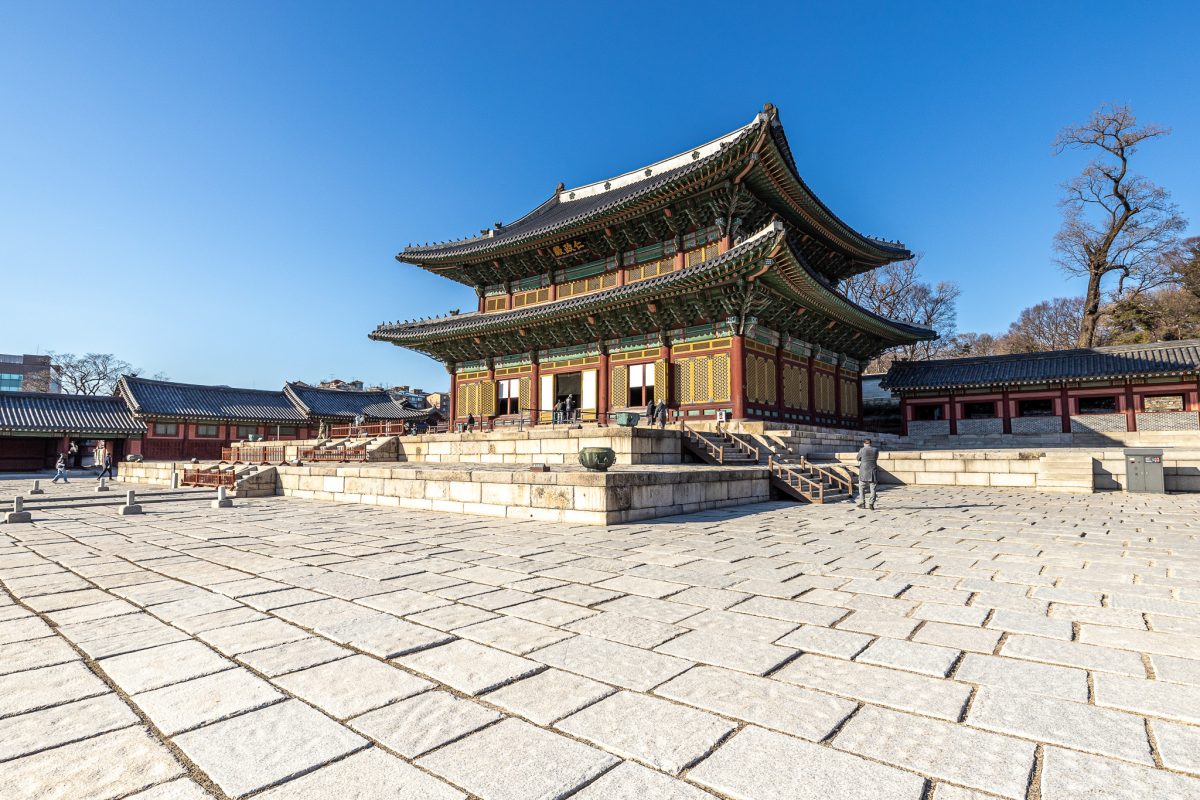
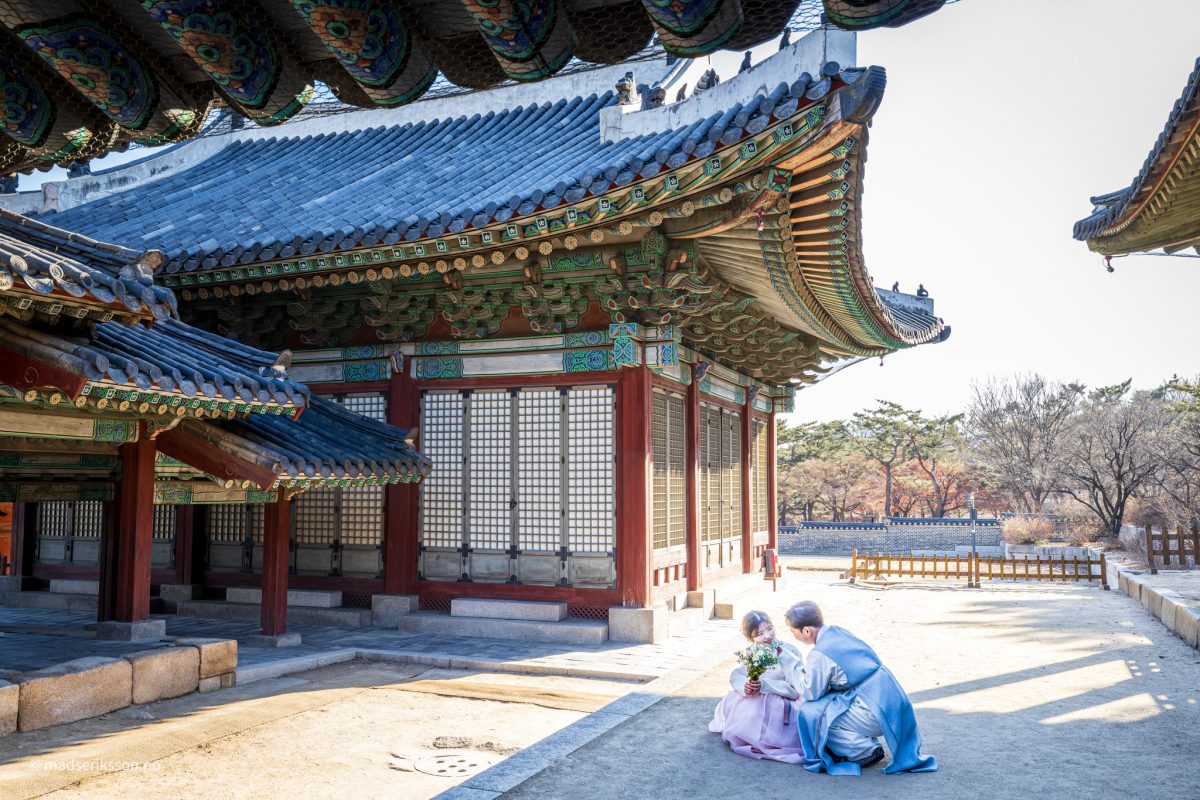
Changdeokgung was built in 1405 as the second palace of the Joseon kings and became the one its kings preferred to live in. The throne hall, Injeongjeon, stands on a stone terrace at the head of a courtyard of flagstones; the present building dates from 1804 and is a National Treasure. Visitors in hanbok, the traditional dress hired nearby, sit on the steps and pose under the painted eaves, and in these frames they give the grey stone and green-and-red woodwork a sudden burst of colour. A few streets west, Bukchon is a hillside of hanok, the low tiled houses of old Seoul, with stone-and-plaster walls lining lanes that slope down towards the palaces.
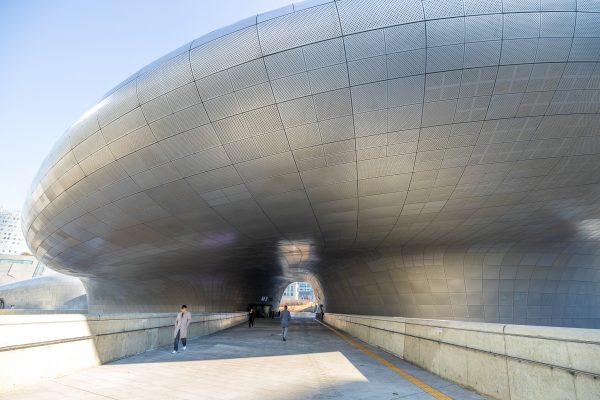
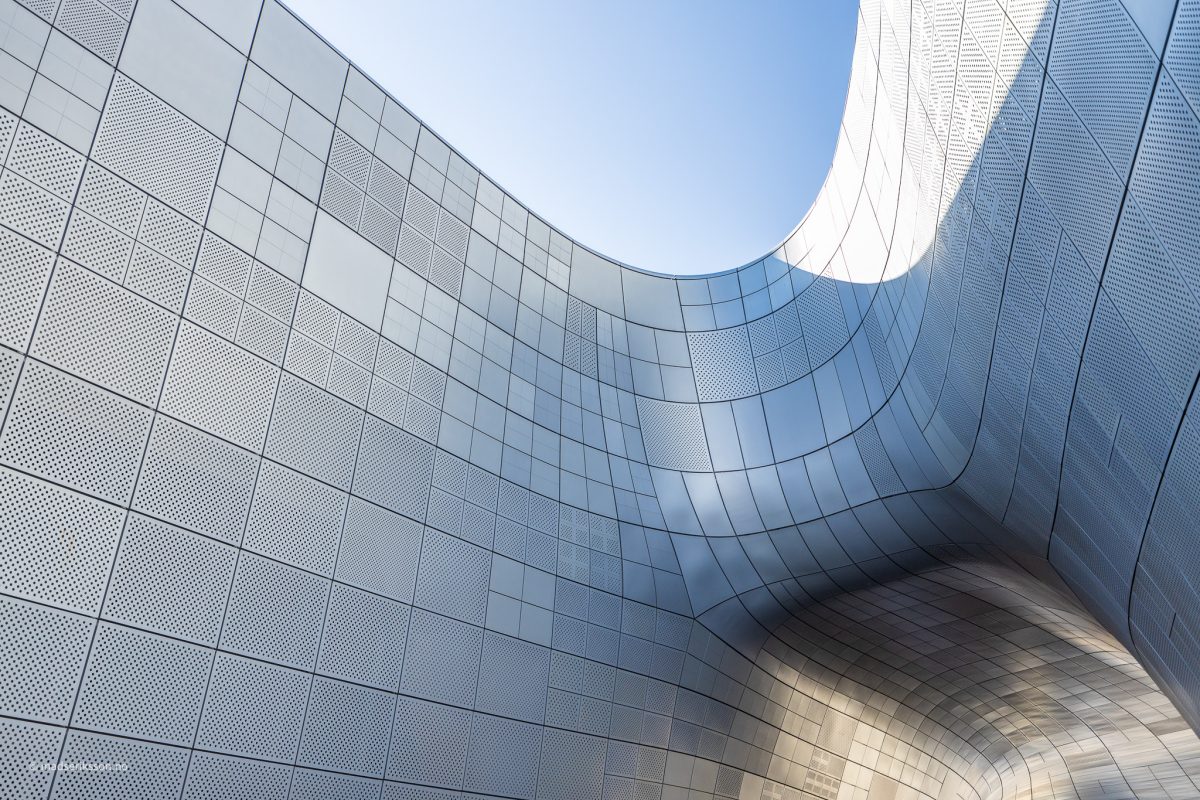
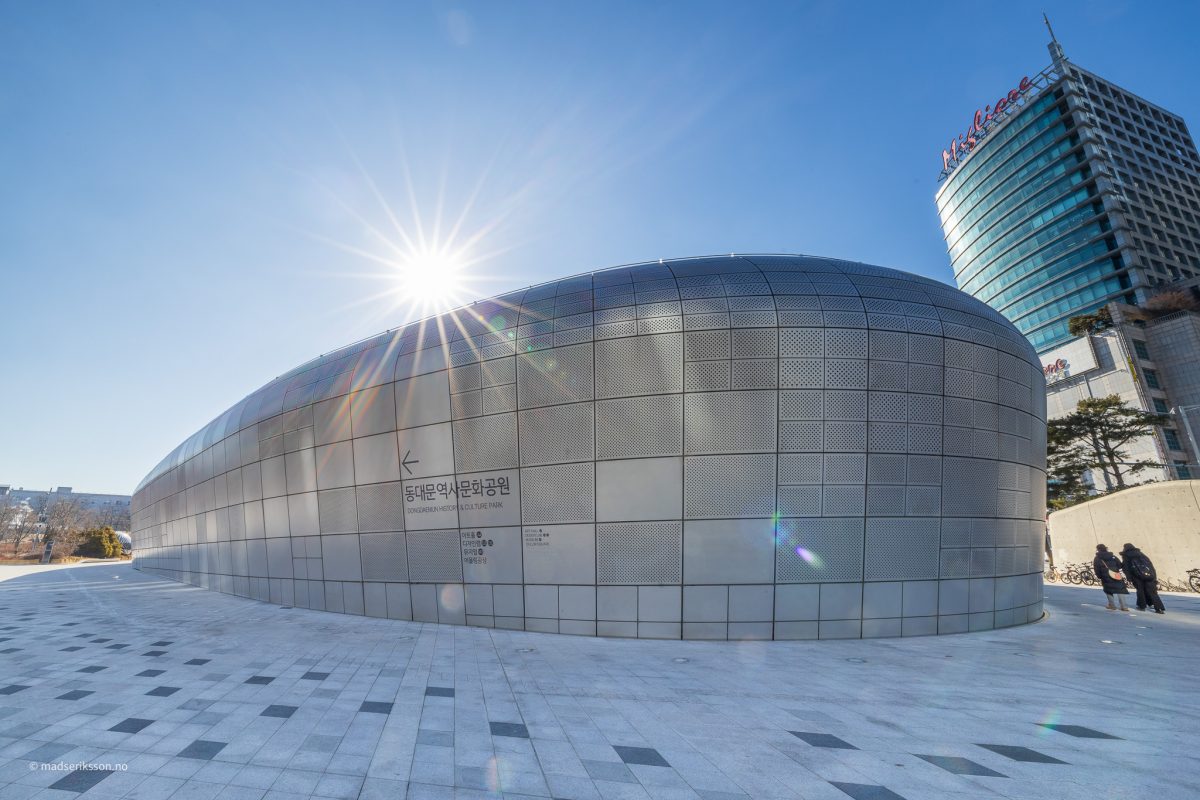
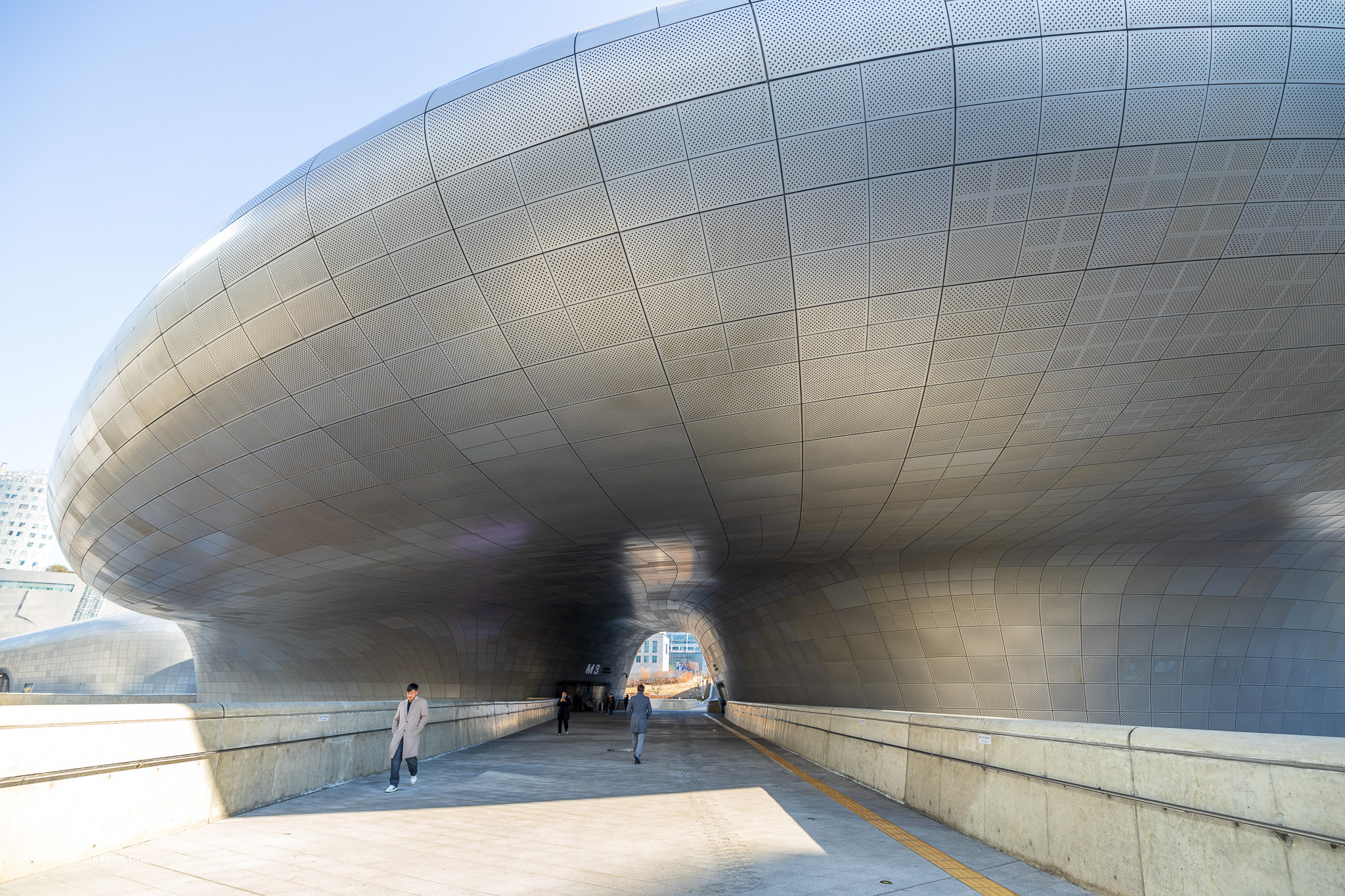
Dongdaemun Design Plaza is the opposite end of the same story. Opened in 2014 on the site of the demolished Dongdaemun Stadium, Zaha Hadid’s building has no straight lines at all: its skin of perforated aluminium panels flows over walkways, folds back on itself and opens in long curving mouths to the sky. In low winter sun the metal reads as pale silver, and the frames here follow the roof edge sweeping overhead, the hollow beneath the belly of the building and the sun flaring off its flank.
Steam in the Food Alley
Mung-bean pancakes, sausages, tteokbokki and diners on benches in a market that has fed the city since 1905.
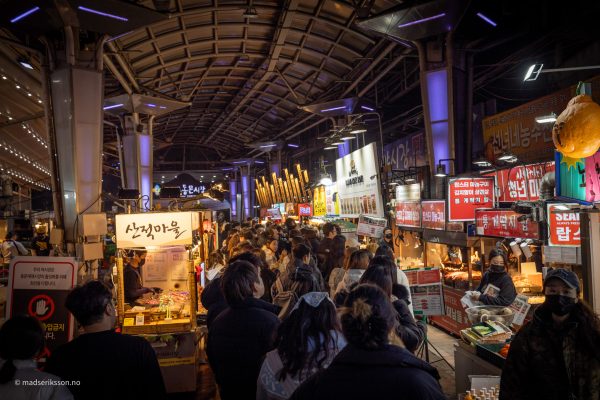
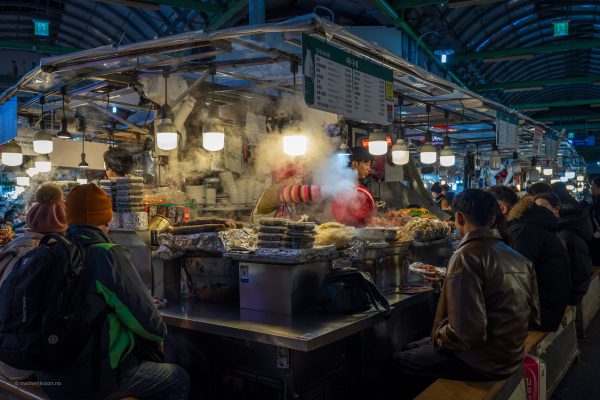
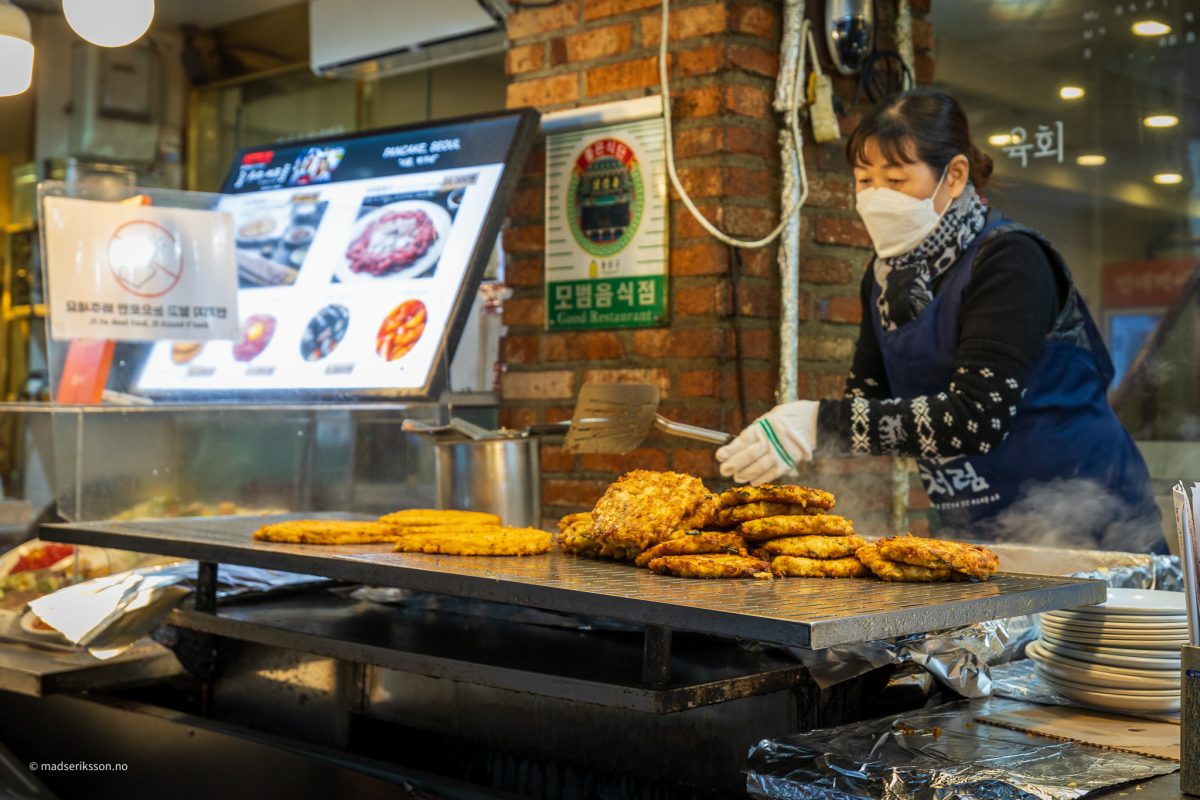
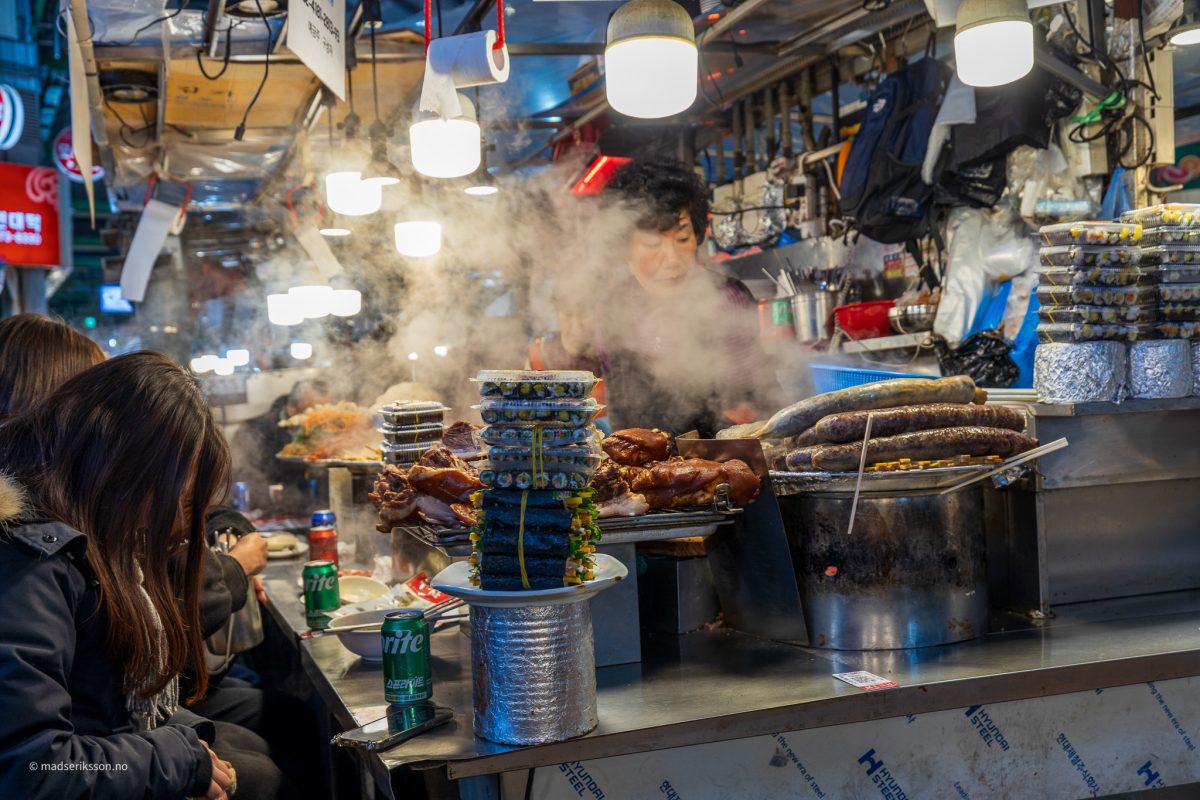
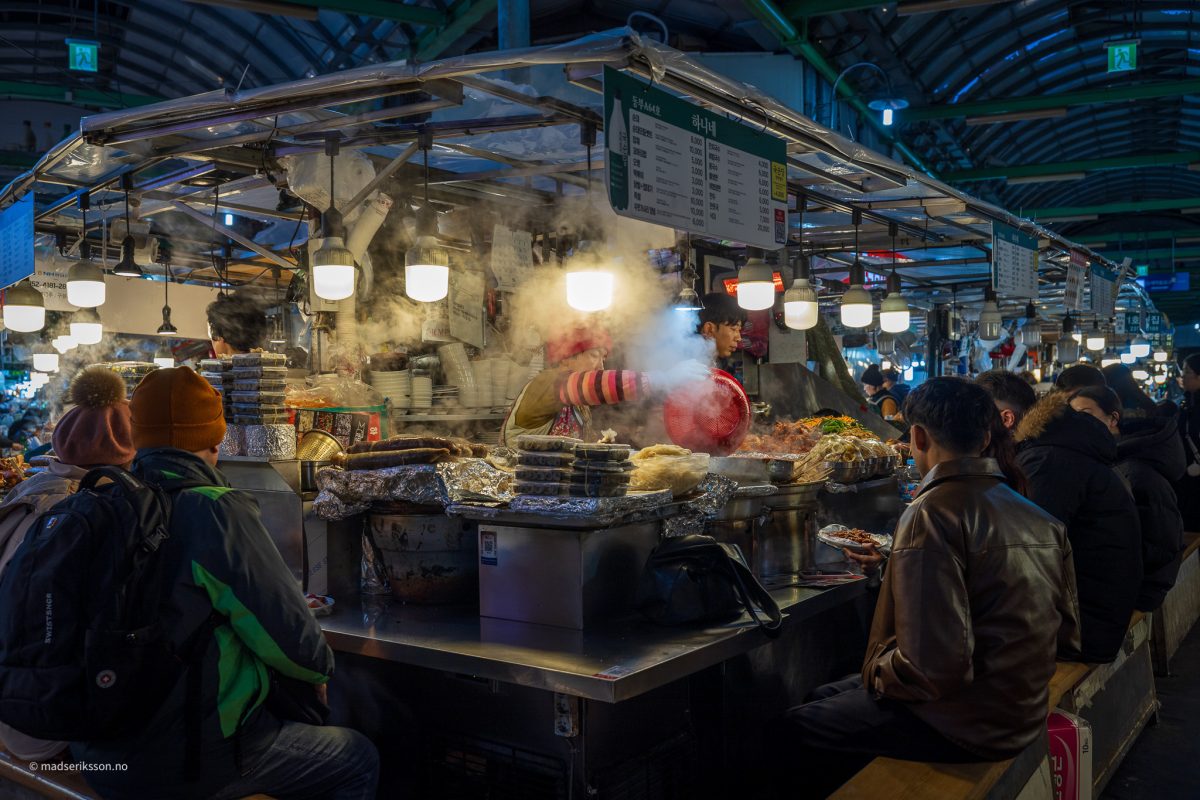
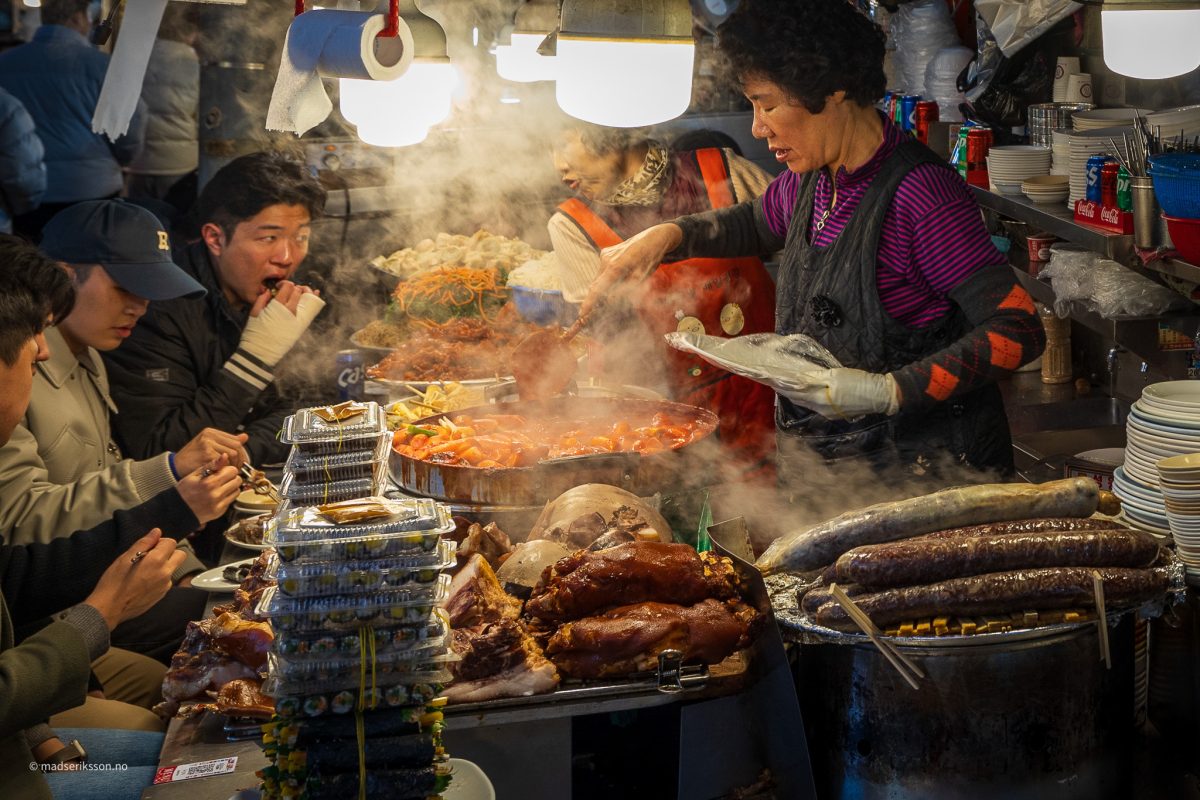
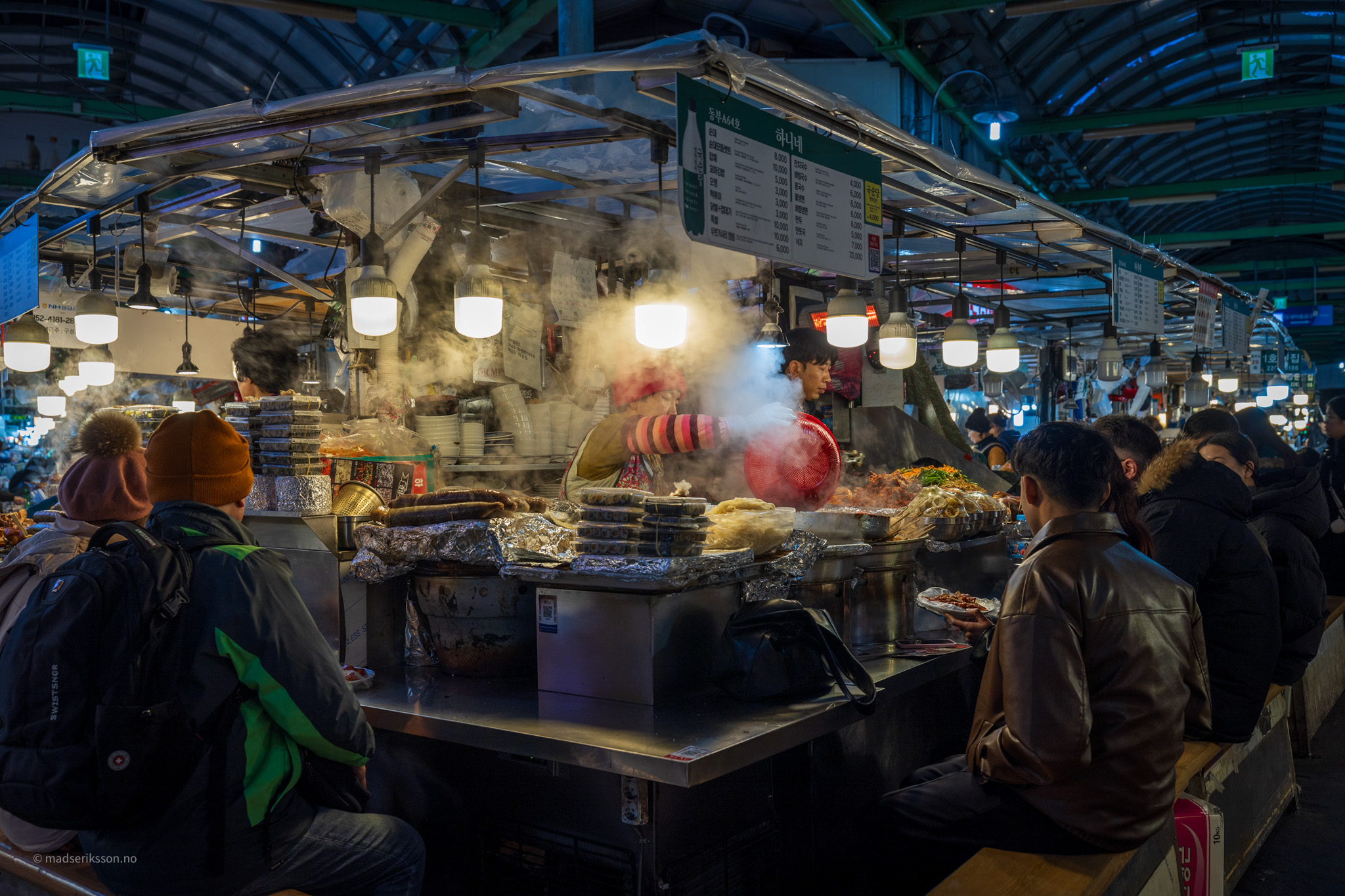
Gwangjang Market was founded in 1905 and is one of the oldest surviving markets in Seoul. Its food alley is a covered lane of stalls under strings of bare bulbs, each with a griddle or a vat of broth and a row of stools or benches on either side. The frames show the specialities: a vendor in a mask turning bindaetteok, the mung-bean pancakes that are the market’s best-known dish, on a hot plate; towers of steamed sausage, kimbap and fish cakes piled under the lamps; and customers in winter coats hunched over bowls while the steam rises around them. The market draws something like 65,000 people a day, and in January the warmth of the stalls is part of the draw.
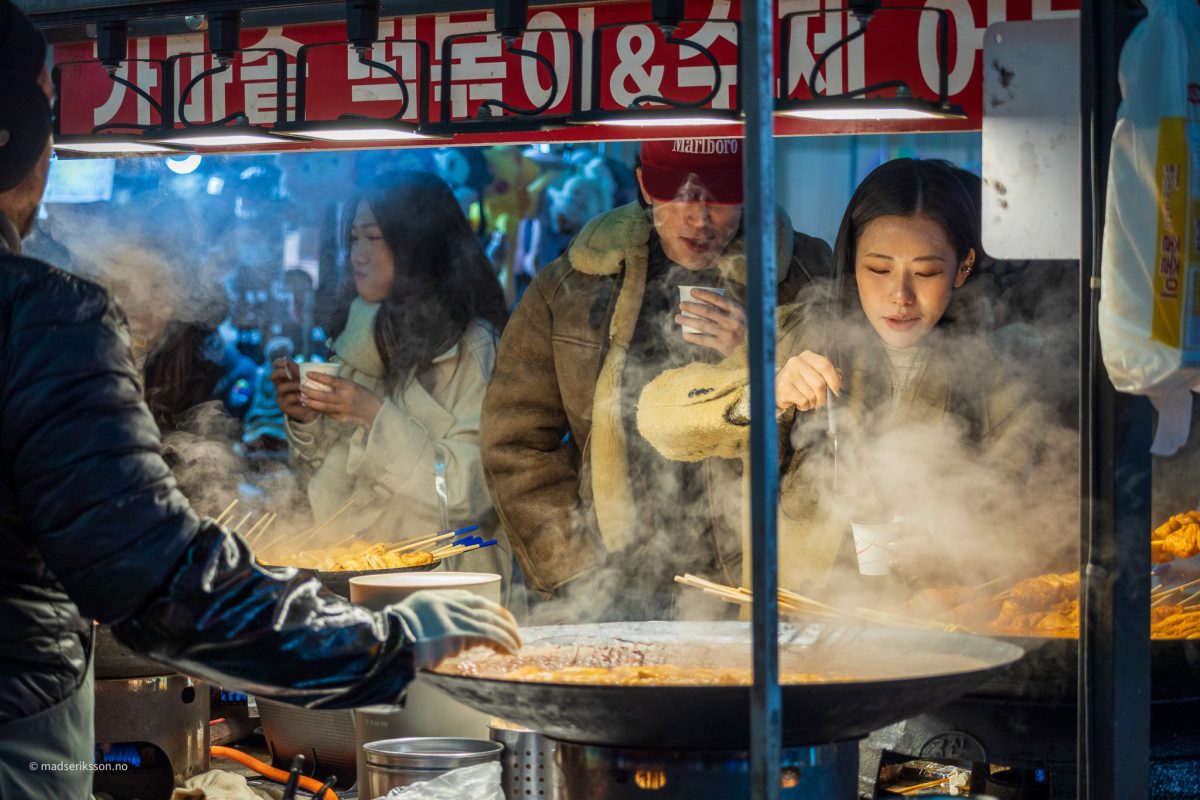
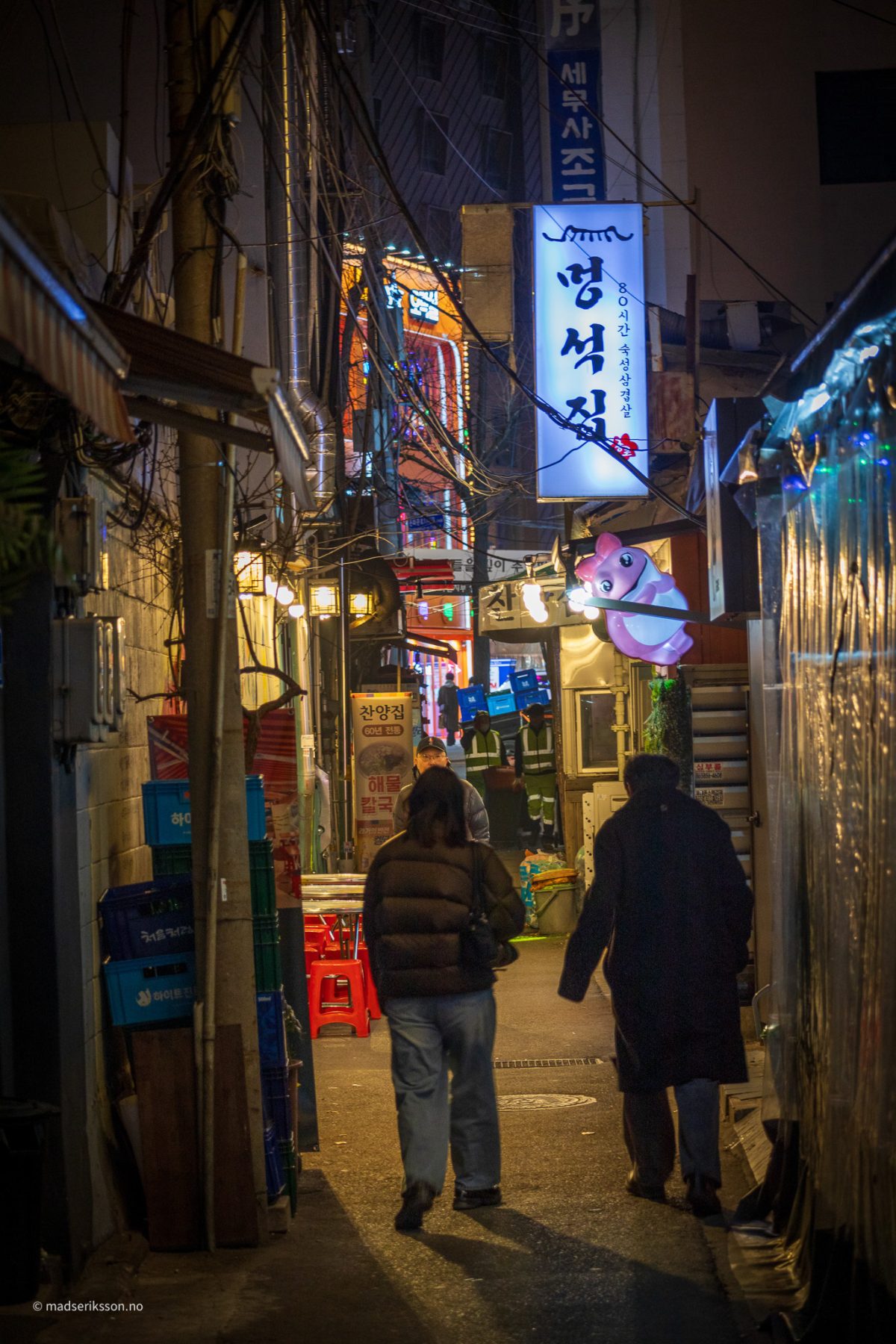
The same scene repeats on the street outside. One frame catches two diners at a tented stall eating tteokbokki and fish cakes straight from the pan in a cloud of steam, under a red-and-white sign. Another follows two figures down a narrow alley of small restaurants after dark, lanterns and signboards lit along both walls, which is where many of Seoul’s meals are actually eaten.
The Gate and the Hill
The great south gate of 1398 in a stream of headlights, and the tower on Namsan above the apartment blocks.
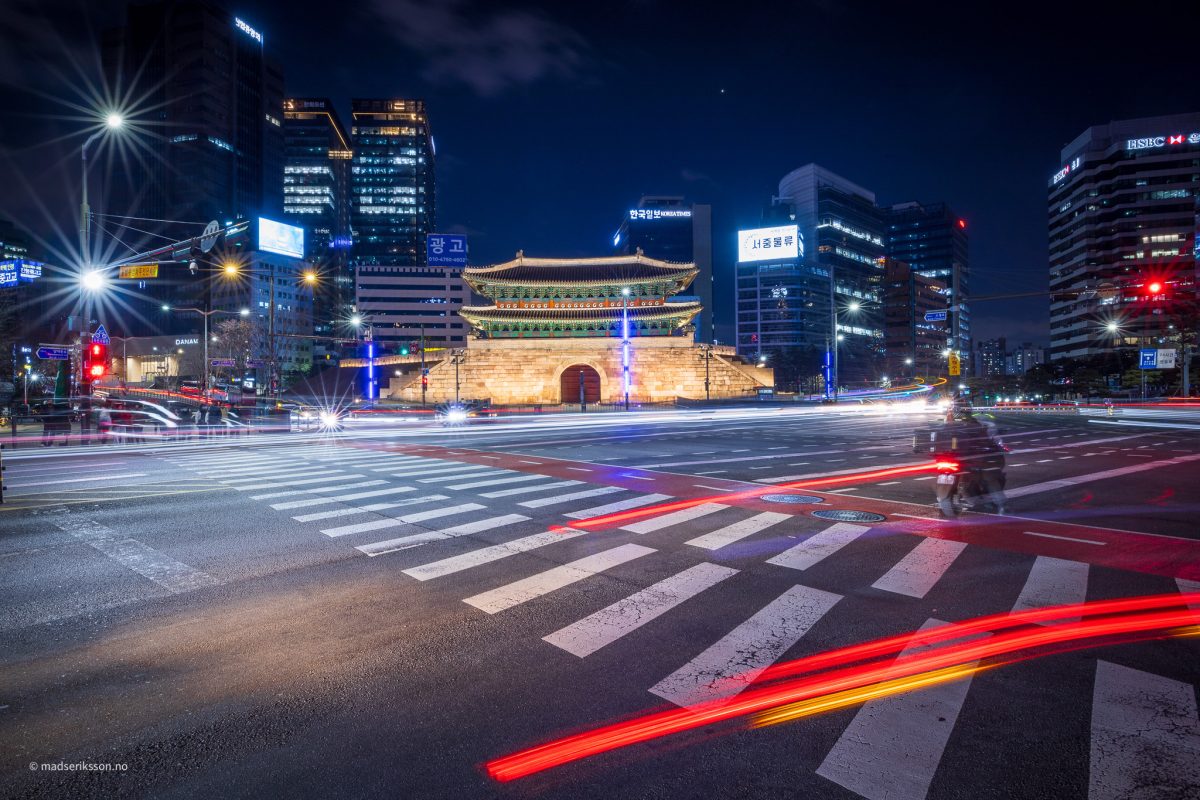
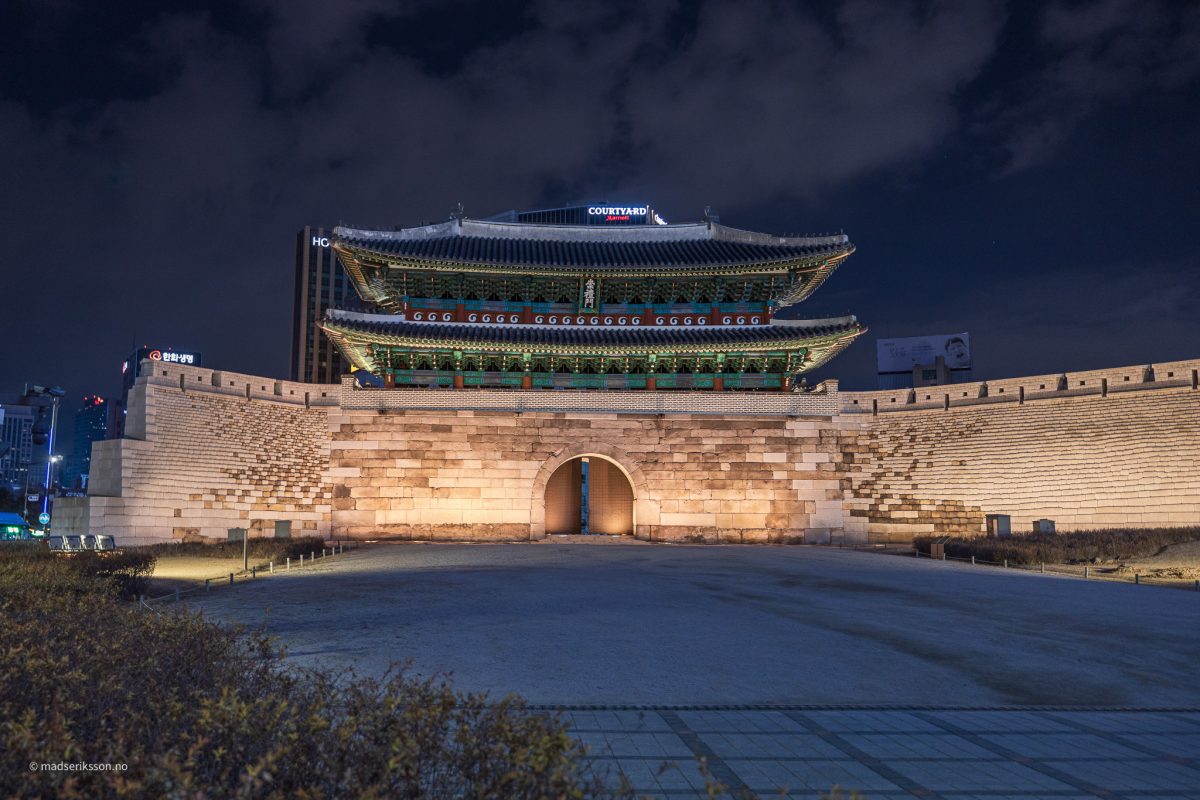
Sungnyemun, better known as Namdaemun, was the main southern gate of the walled Joseon capital. Completed in 1398, it is National Treasure No. 1 and the oldest wooden structure in Seoul, though what stands today is largely a reconstruction: an arson attack on 10 February 2008 destroyed the wooden pavilion, and the gate reopened after five years of rebuilding in May 2013. It now sits on a traffic island ringed by office towers, which is exactly how the frames show it: floodlit stone and painted timber, with the headlights and tail lights of the evening traffic drawn into red and white streaks across the crossing in front.
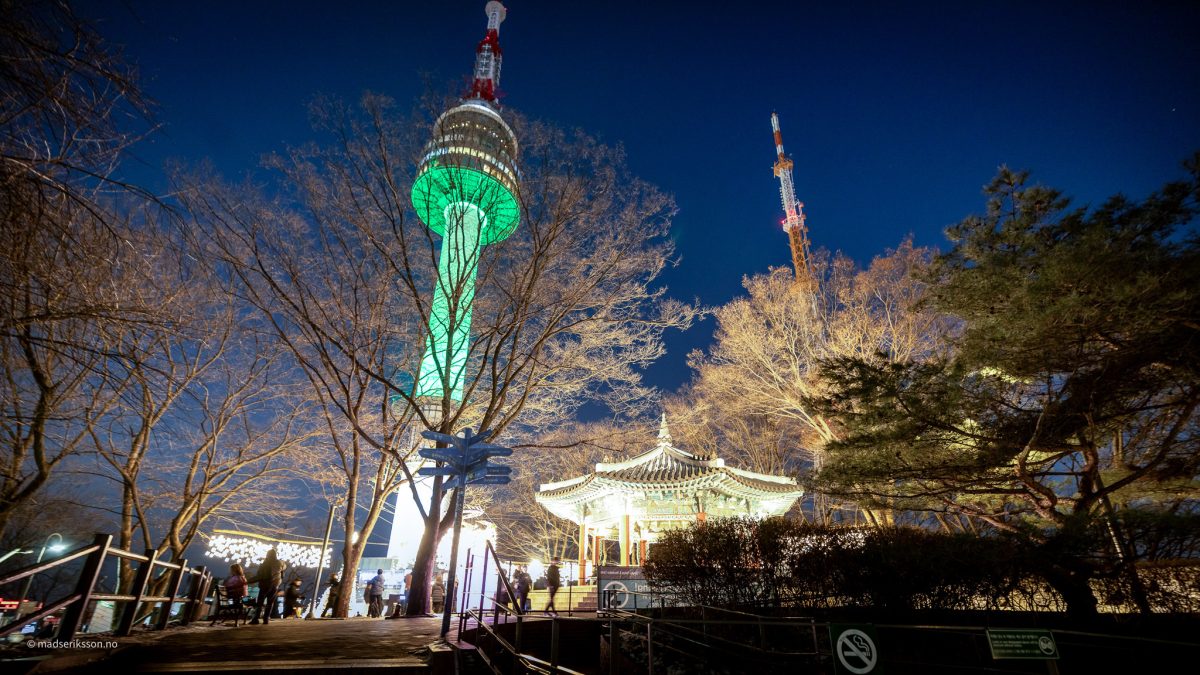
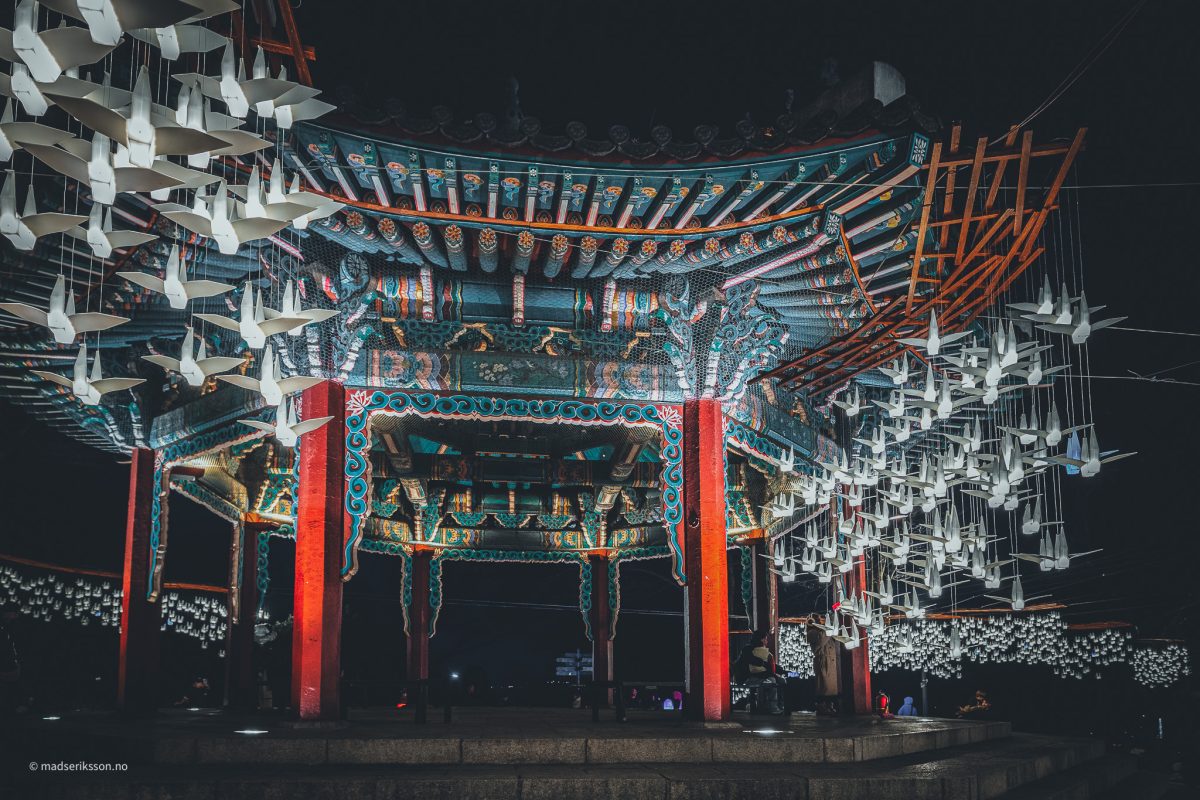
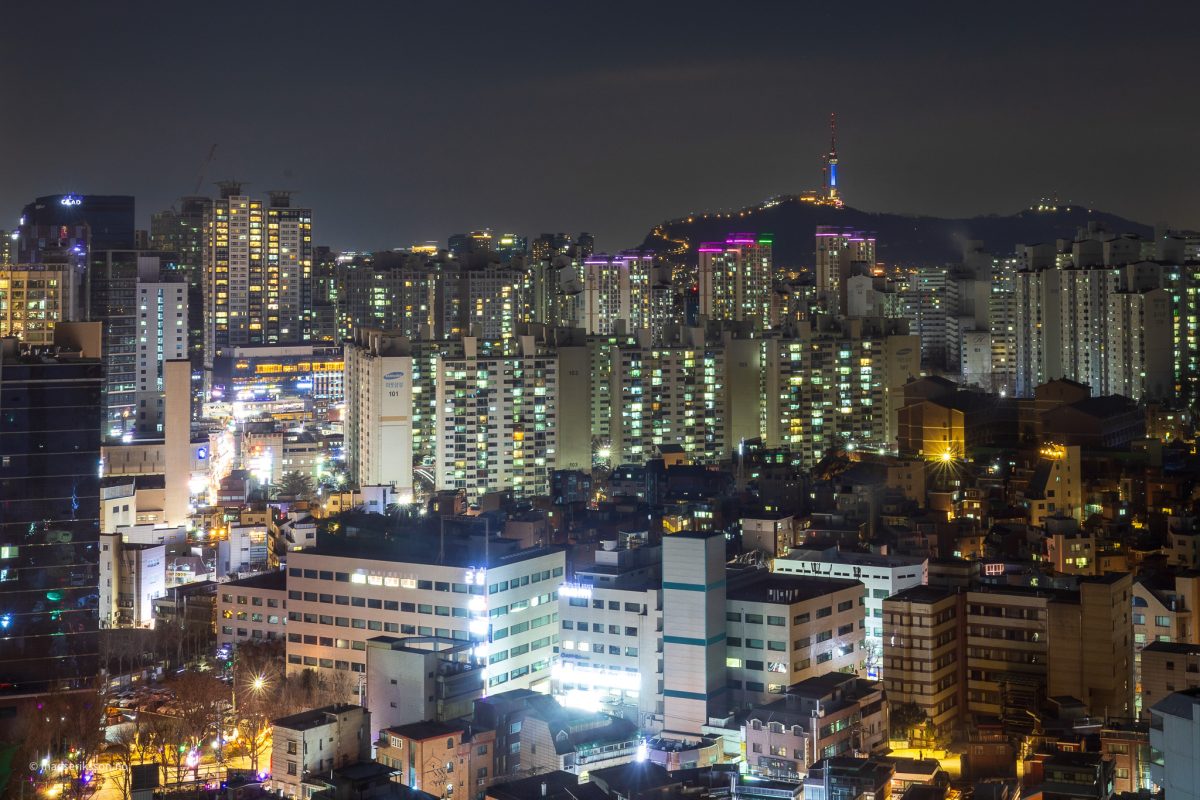
Namsan rises to 243 m just south of the gate, and N Seoul Tower on its summit adds another 237 m. The tower is lit in changing colours; here it glows green above a traditional pavilion and the bare winter trees of the summit terrace, where a second frame shows a pavilion hung with hundreds of white paper birds. From a rooftop in the streets below, the tower is a small bright needle above the lit grid of apartment blocks that fills every valley of the city.
The City in Motion
Wide avenues running to the mountains, neon alleys, a night bus, a Kakao taxi and a square full of flags.
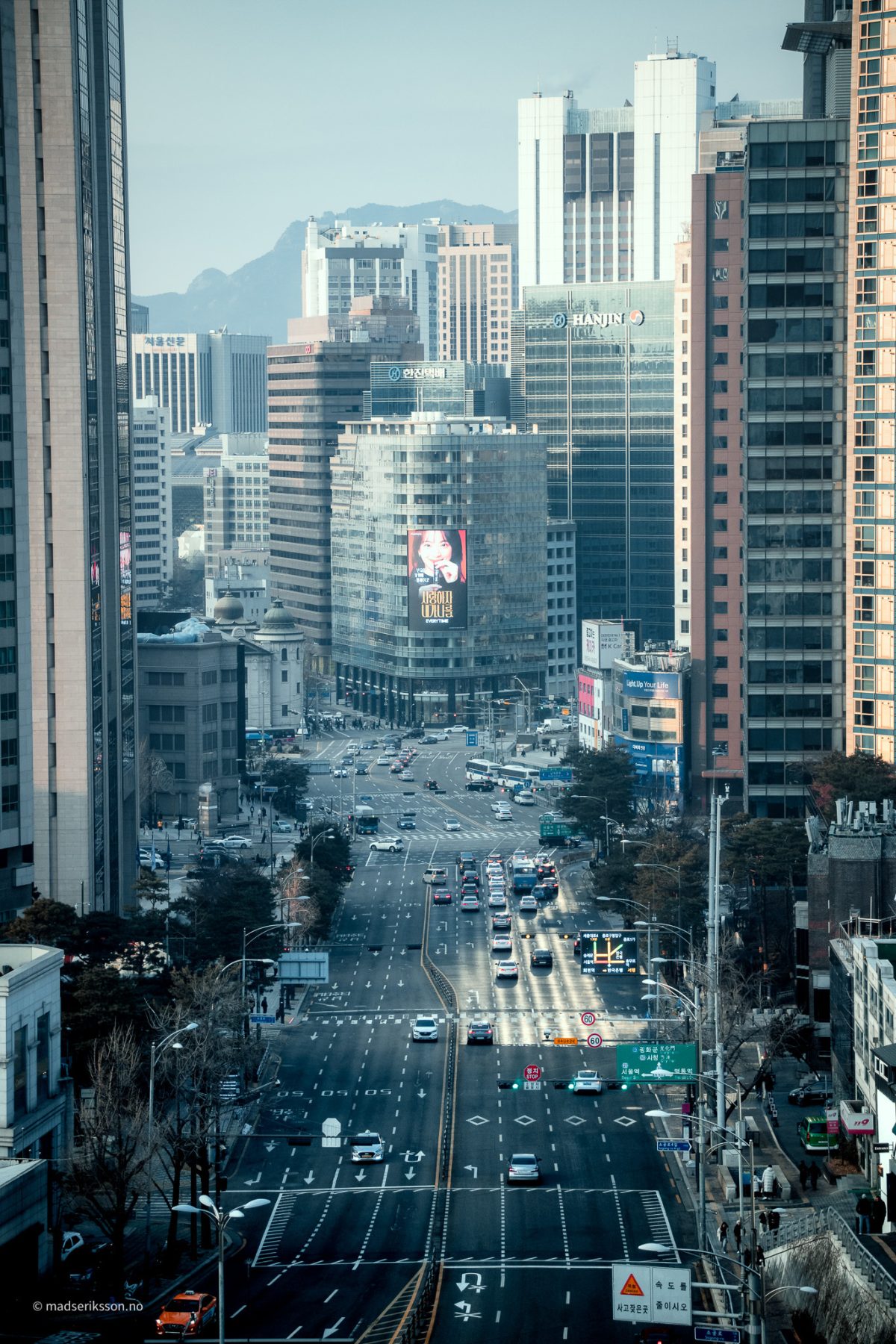
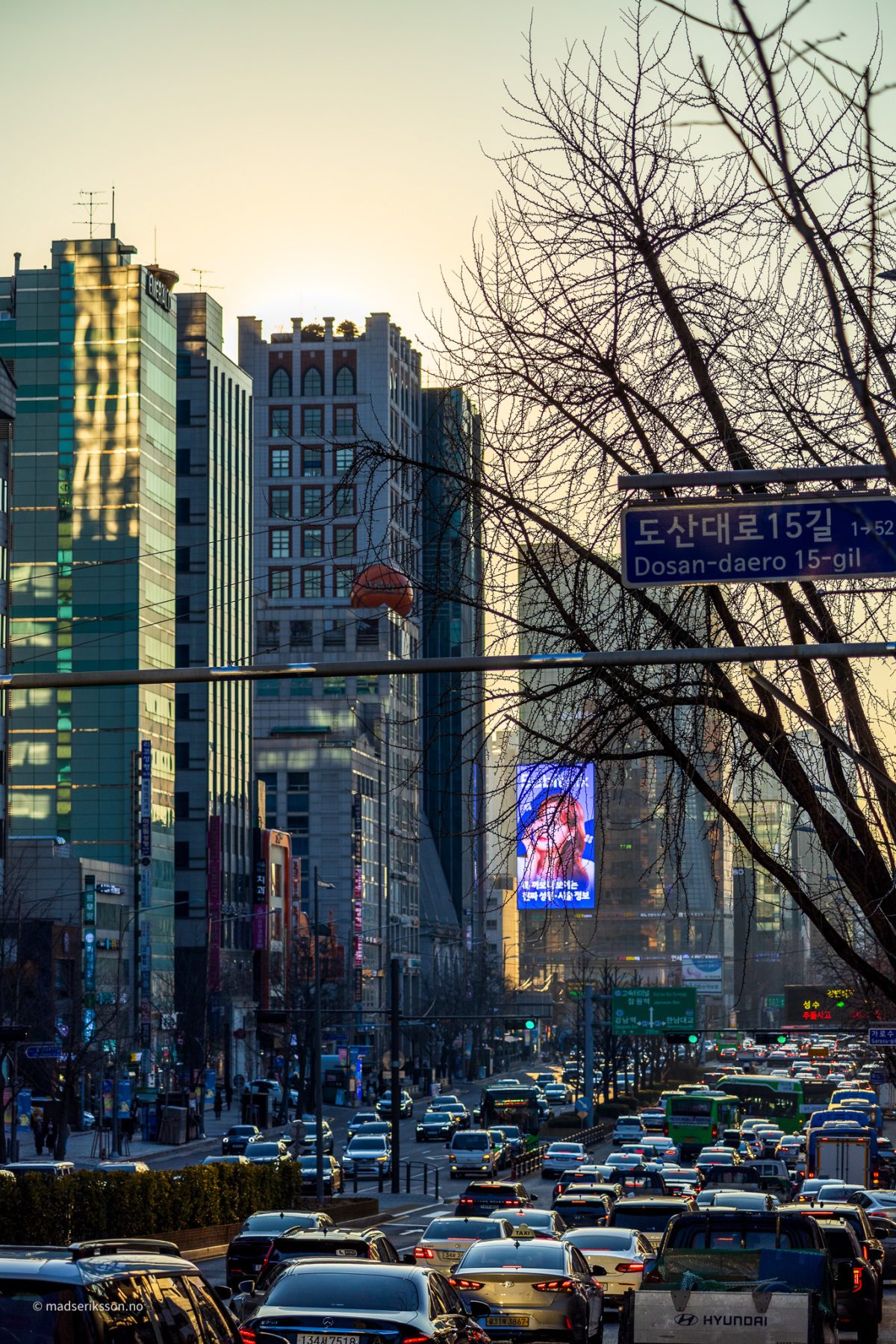
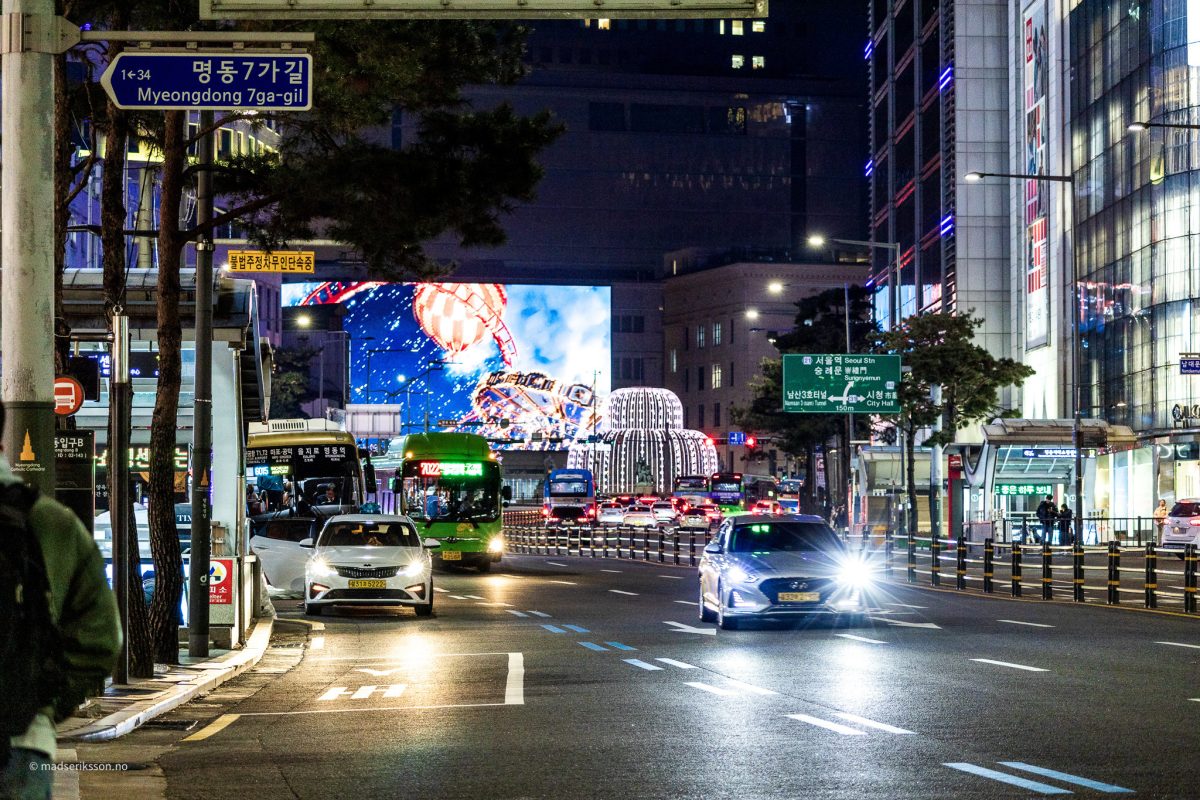
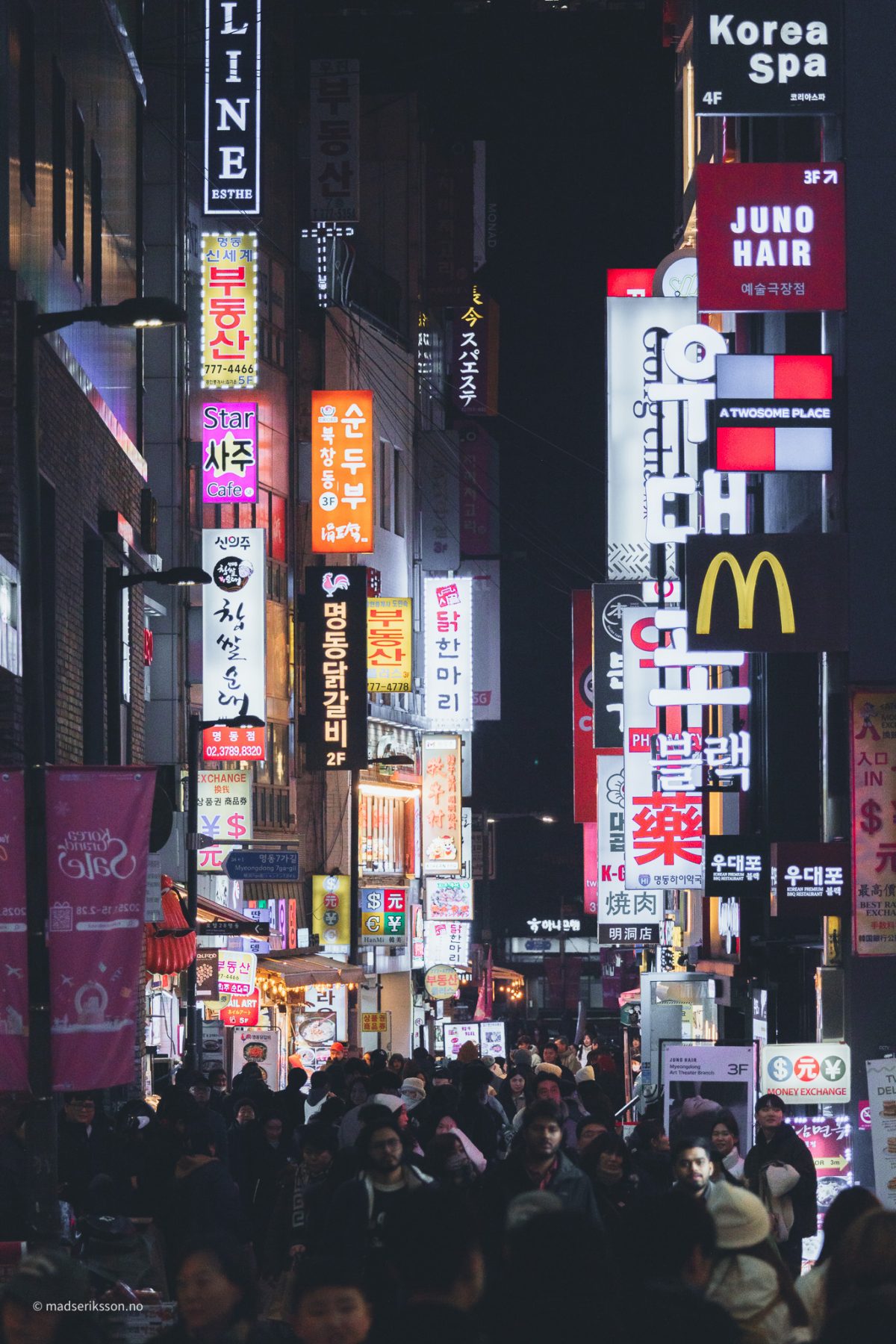
Central Seoul is built on a scale that suits traffic: avenues eight and ten lanes wide run dead straight between the office towers until they end against the granite ridges that enclose the city. One frame looks down such an avenue in daylight, the towers closing in on either side and a mountain filling the gap at the end. After dark the same streets turn into light: a giant video screen above the evening traffic, a bus and a taxi pulling through a junction, and a shopping street jammed with people under a canopy of signs in Hangul.
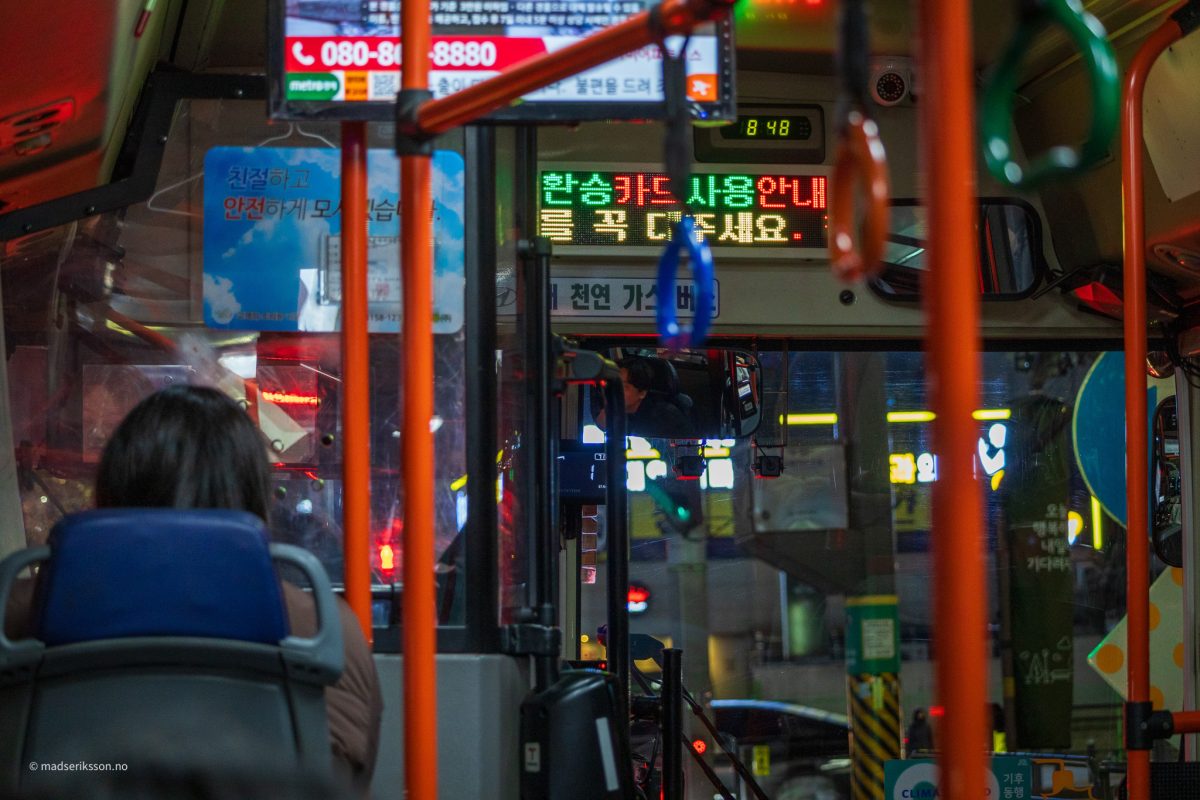
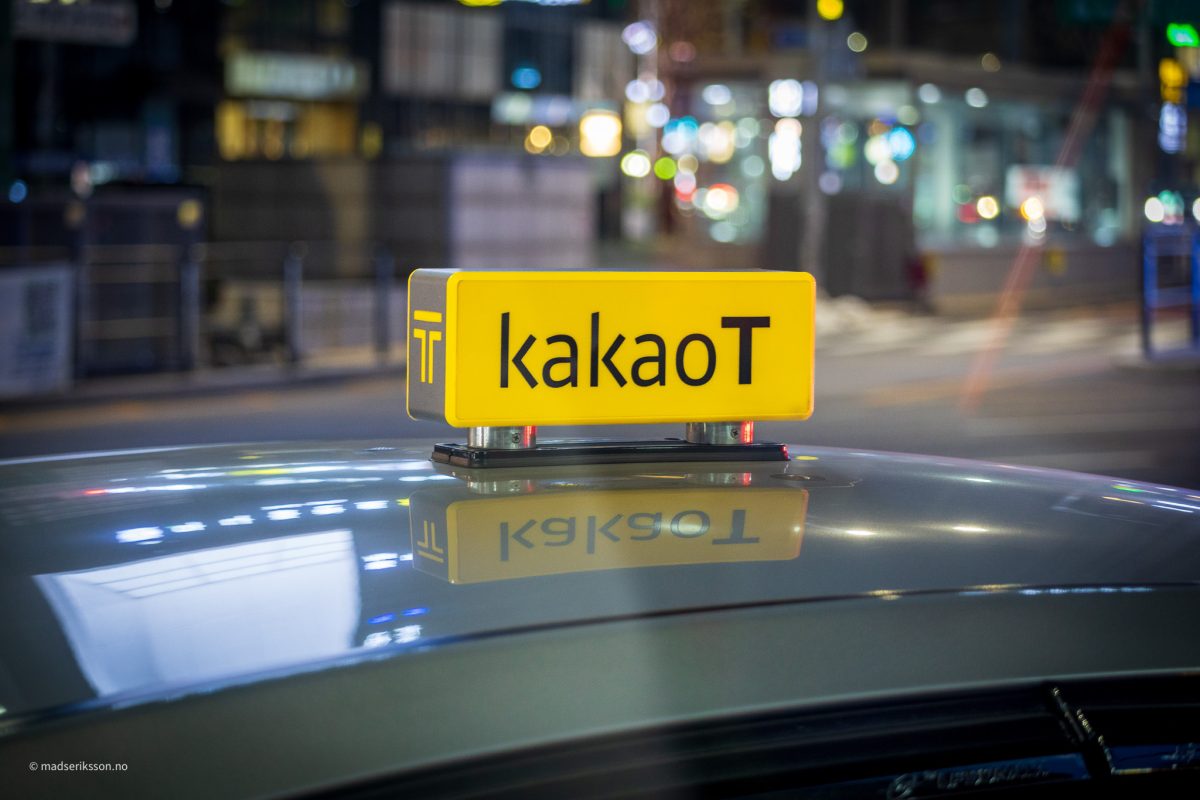
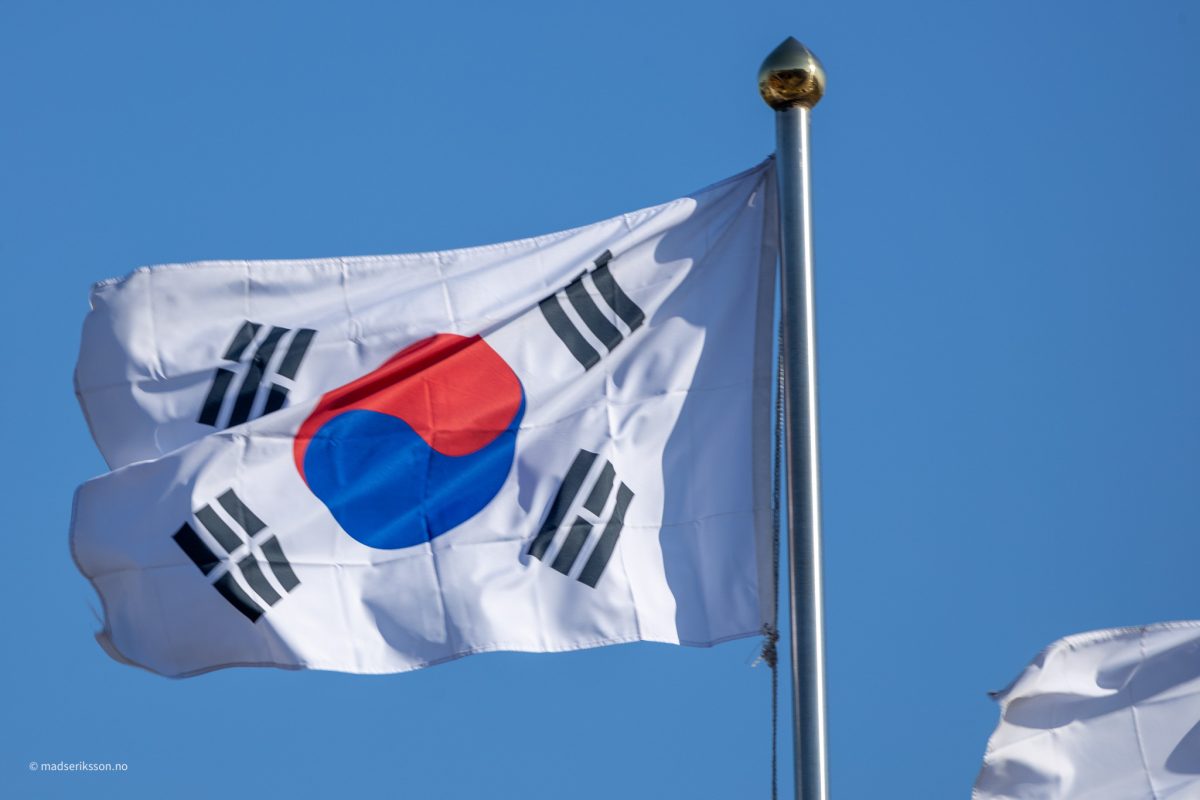
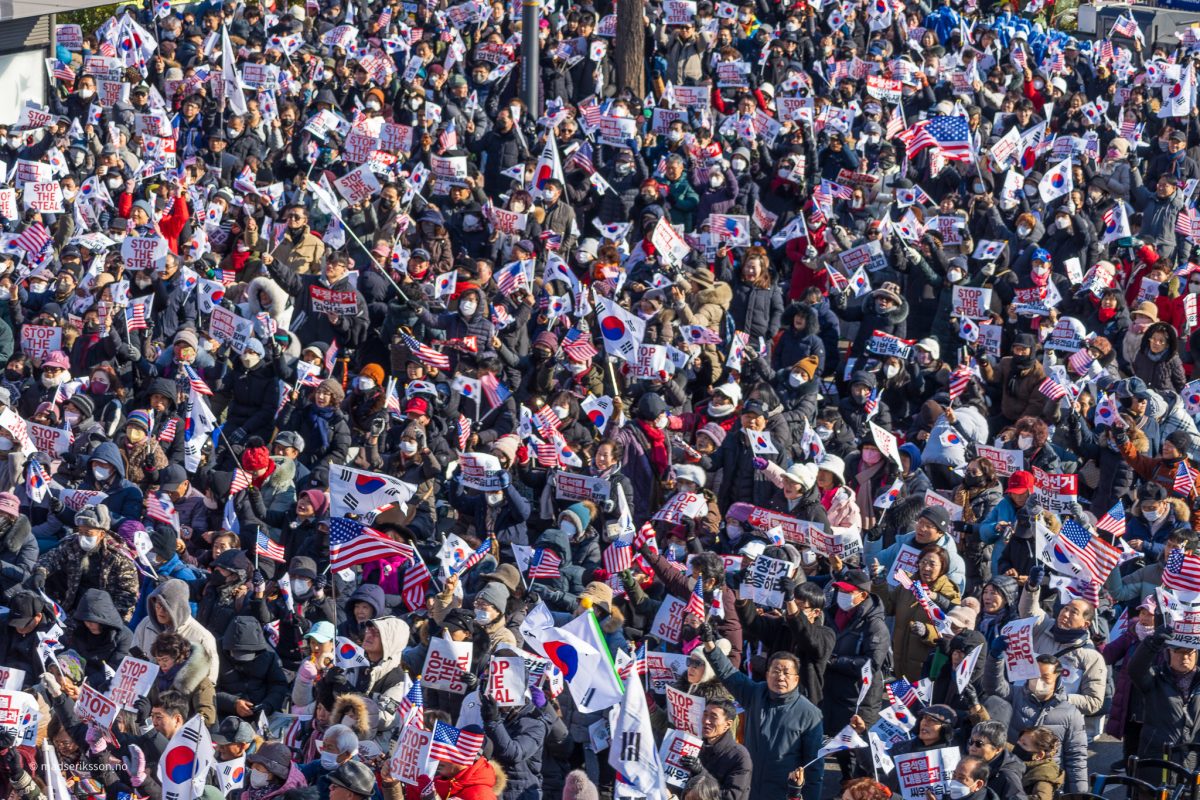
Two frames go inside the system. The first is taken from a seat on a night bus, between orange grab poles, with the route display scrolling in Korean above the windscreen; the second is a close view of a yellow Kakao T sign glowing on a taxi roof, the app that most of the city now uses to hail a cab. The last two are flags: the taegukgi flying against a hard blue sky, and a crowd at a rally packed shoulder to shoulder and waving South Korean and American flags together.
South of the River
Bear sculptures on K-Star Road, a Burgerman mural, and boulevards of towers and screens after dark.
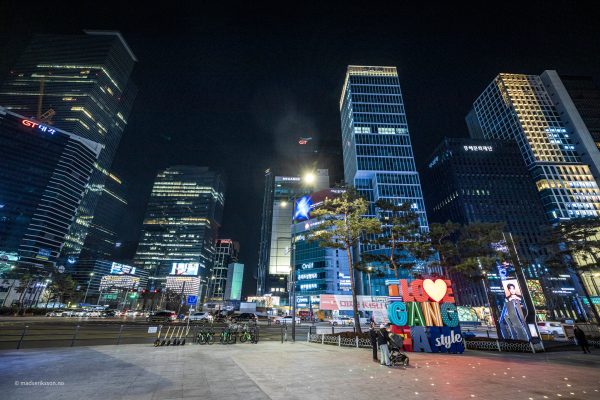
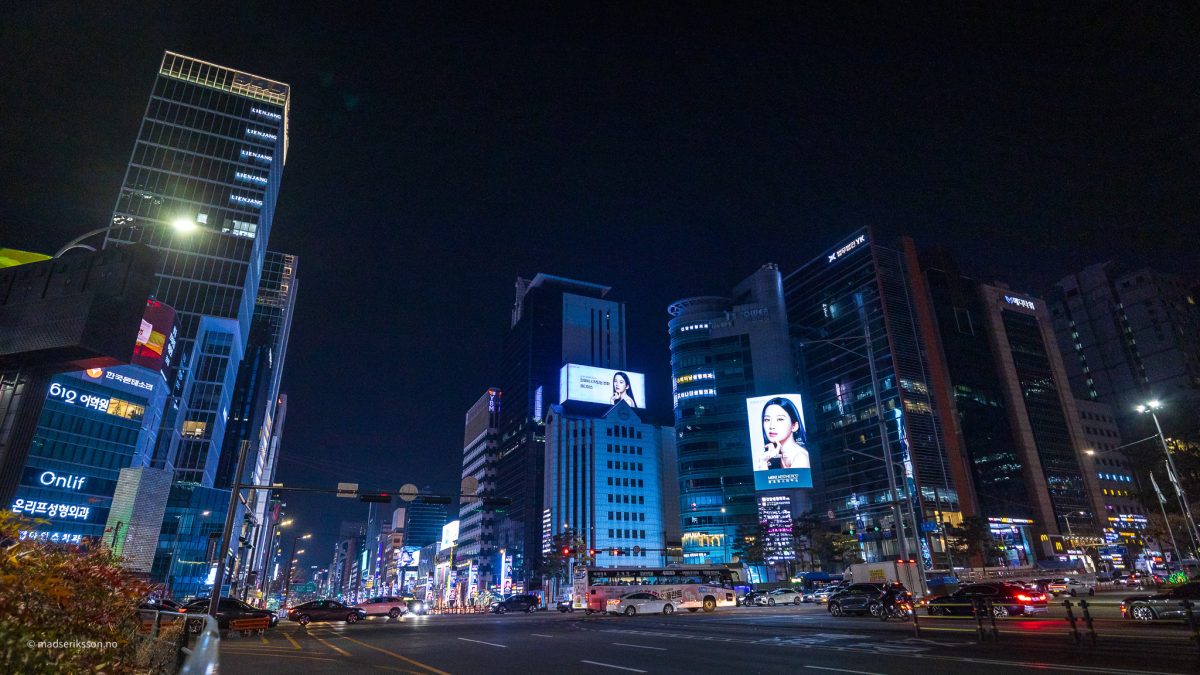
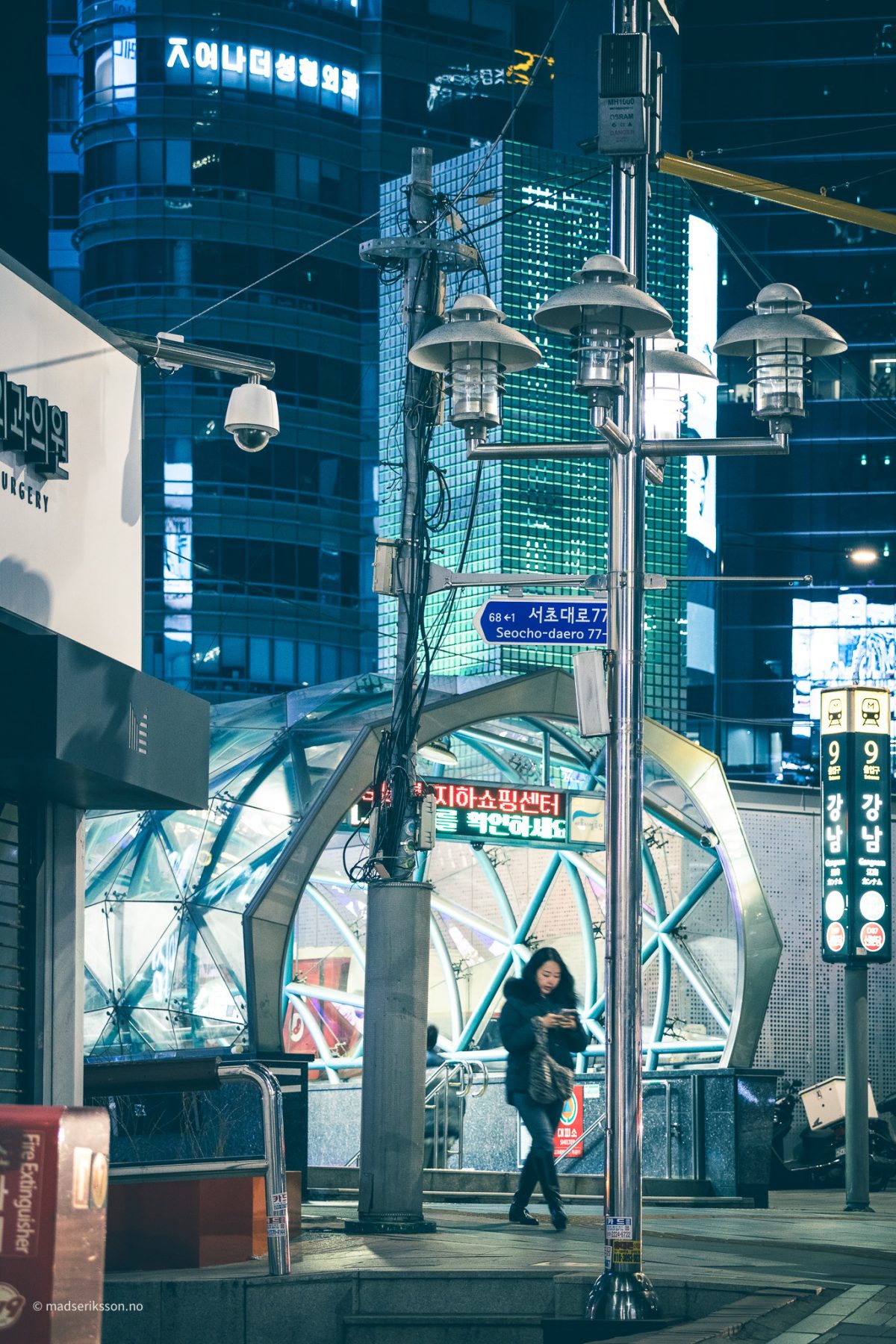
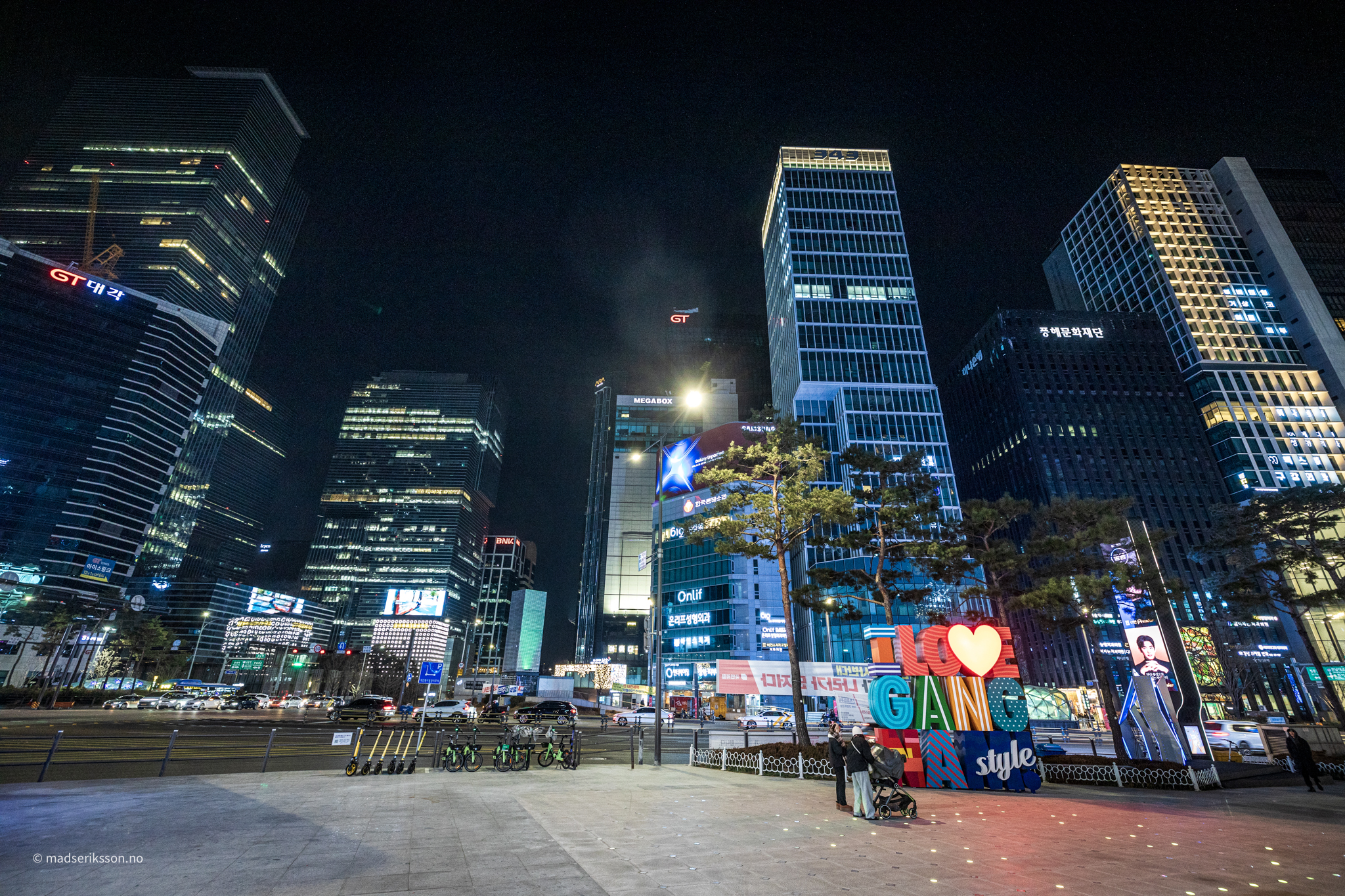
Gangnam means simply south of the river, and until the 1970s most of it was farmland. It was planned and built almost from nothing as the city expanded across the Han, and today its grid of boulevards, offices, clinics and entertainment agencies is the Seoul that the 2012 song made famous. The frames here are all taken after dark, when the district is at its most itself: a skyline of glass towers lit floor by floor, a wide boulevard lined with video screens and tail lights, and the glass-domed entrance to Gangnam Station on its corner under the high-rises.
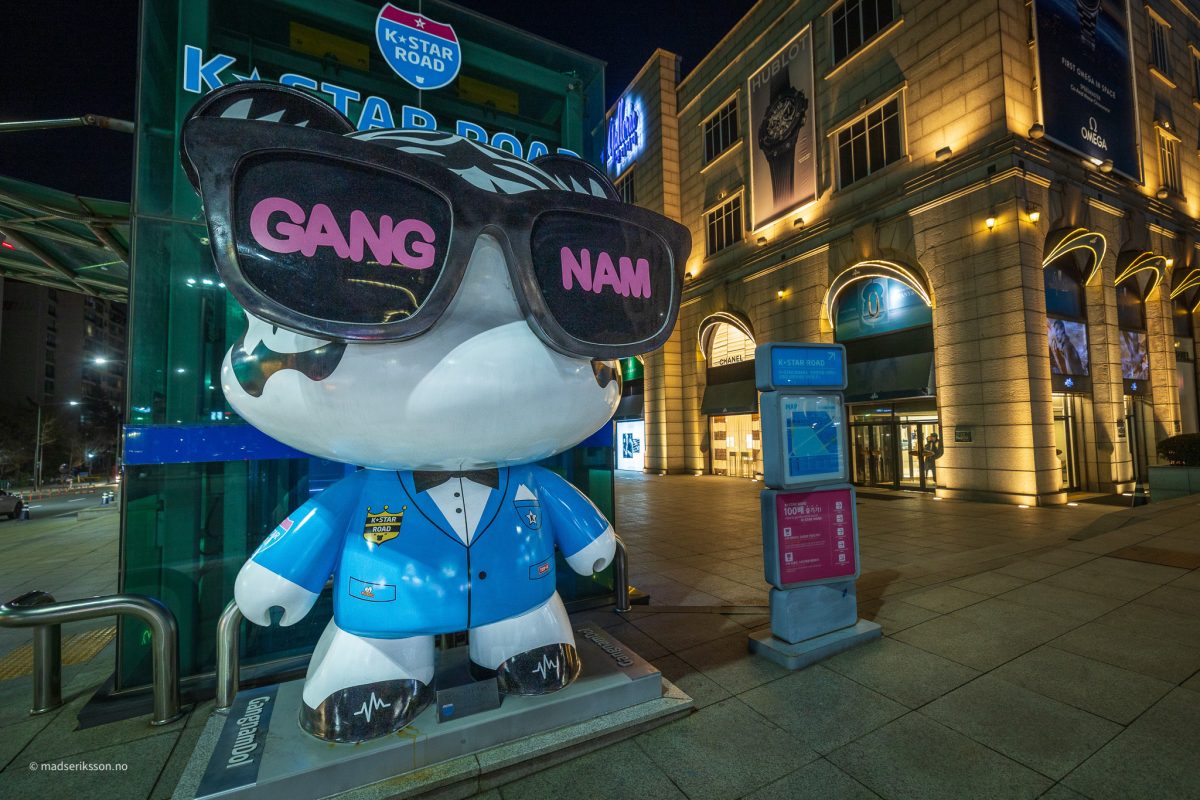
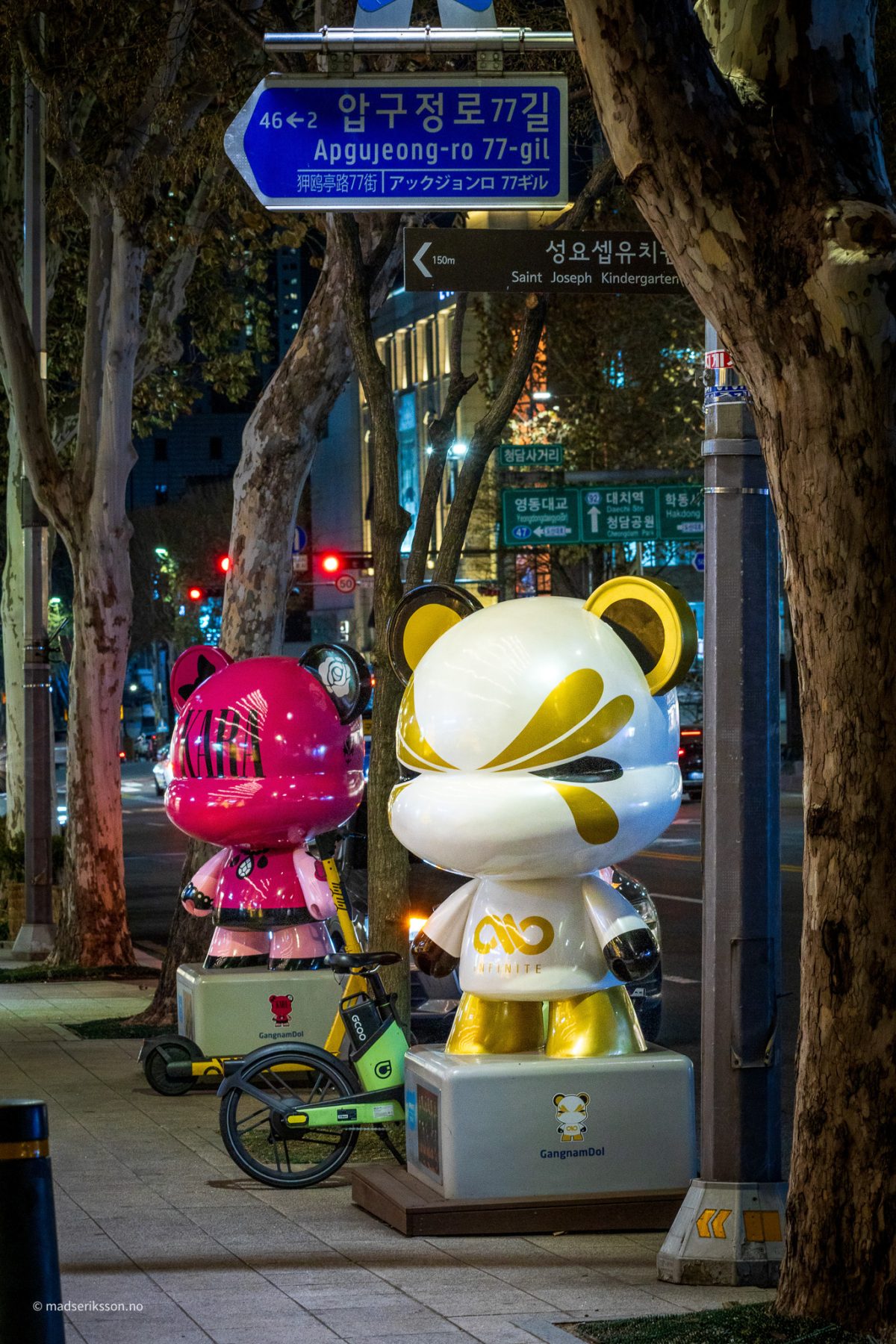
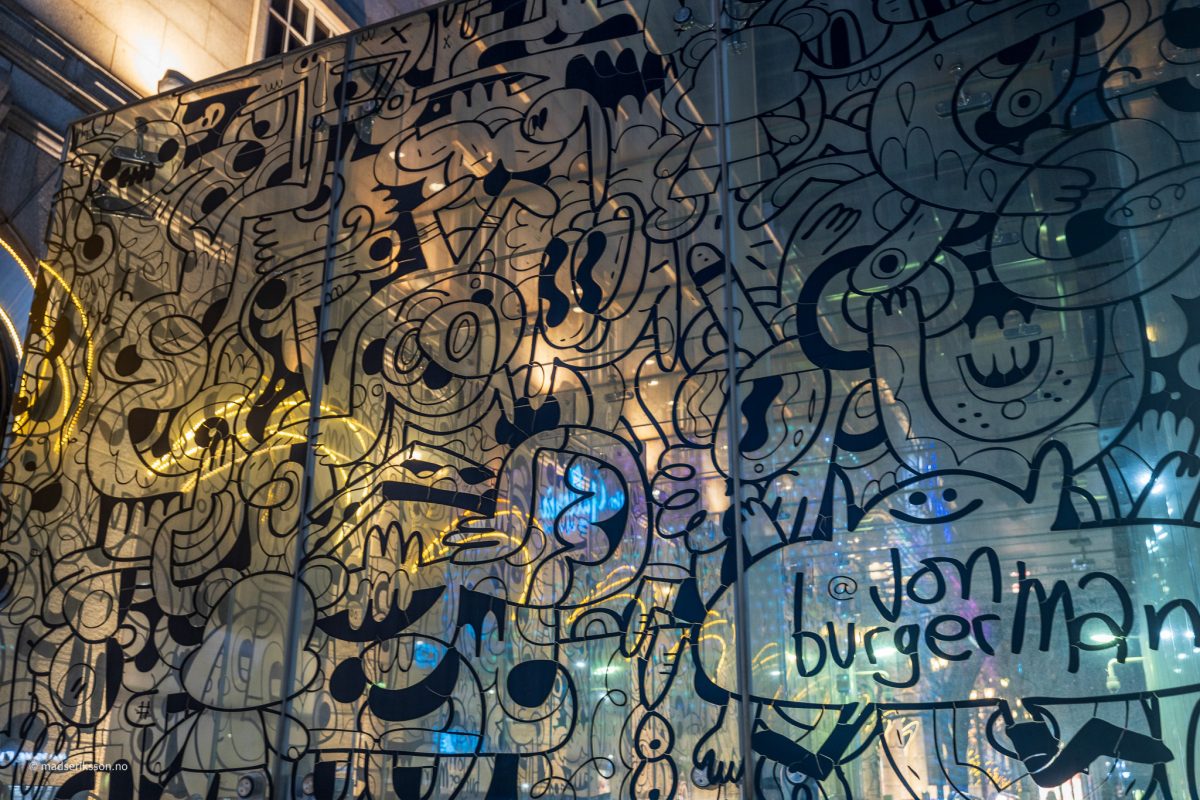
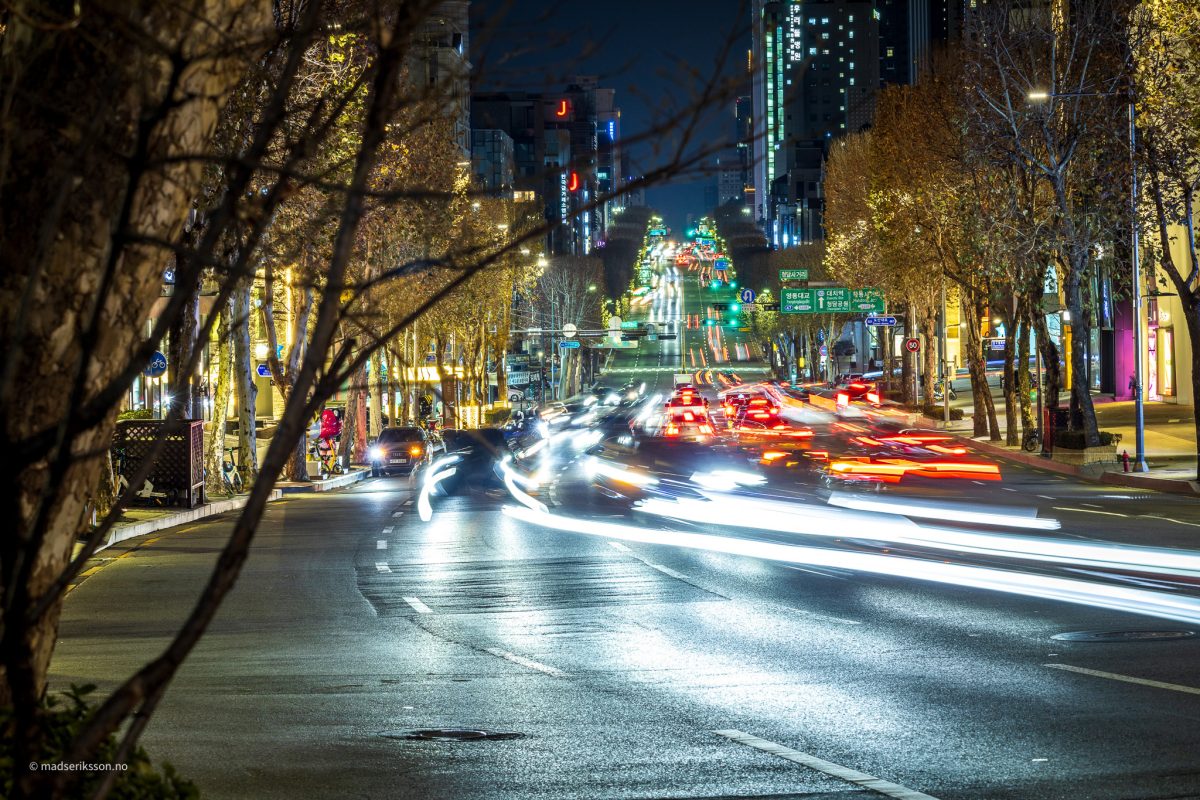
Along K-Star Road in Apgujeong, a row of oversized bear figures known as GangnamDols stands on the pavement, each decorated for a K-pop act; one in sunglasses carries the word GANG NAM across its lenses. A black-and-white doodle mural by the British artist Jon Burgerman covers a wall of glass panels, lit from behind. On a tree-lined avenue nearby, the trees are wrapped in festive lights and the traffic streams between them as blurred ribbons of white and red.
The River from Above
The frozen Han, its bridges and the whole basin of the city, by night and at dawn.
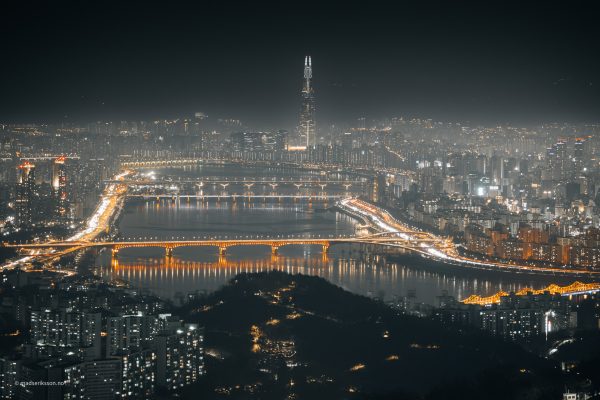
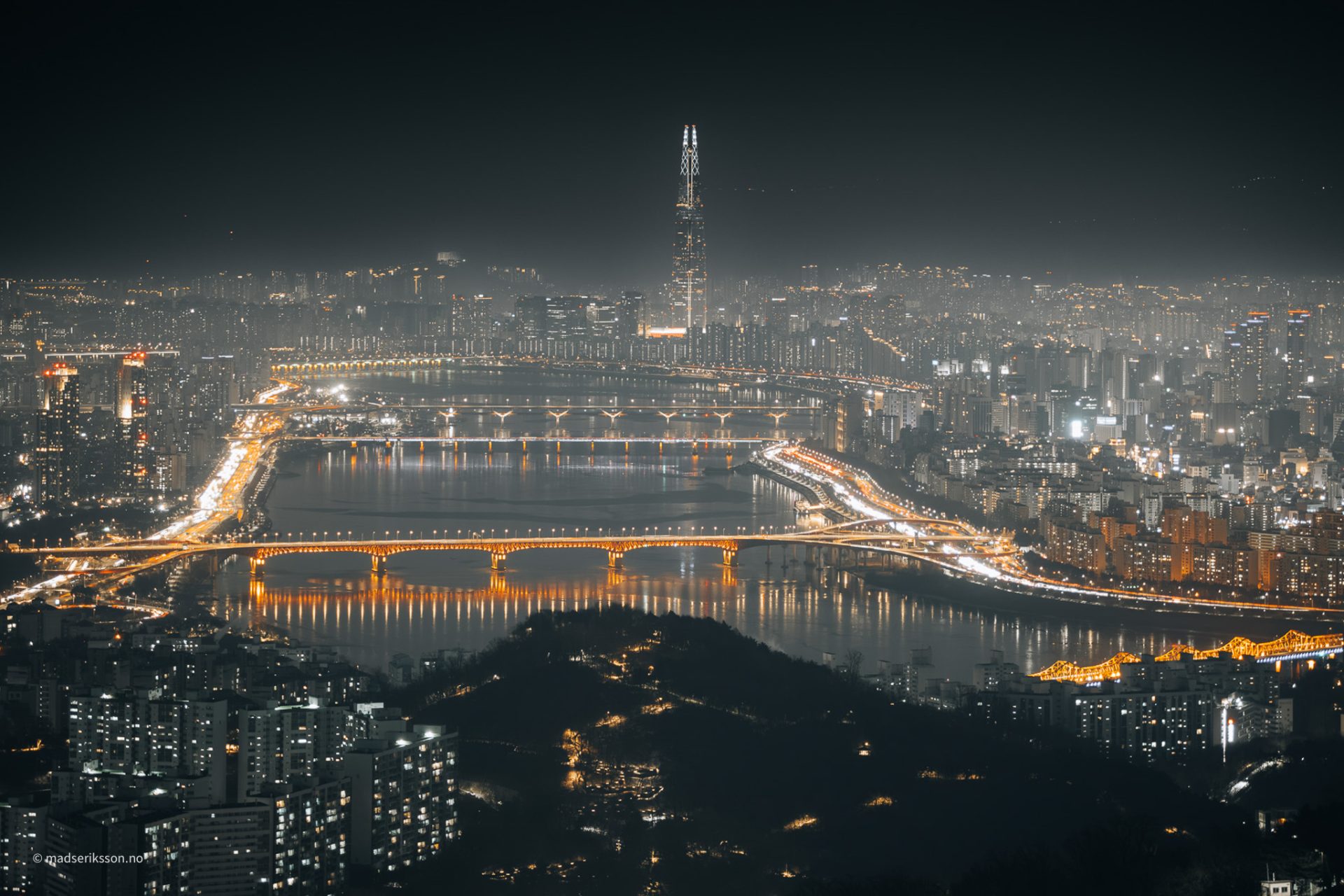
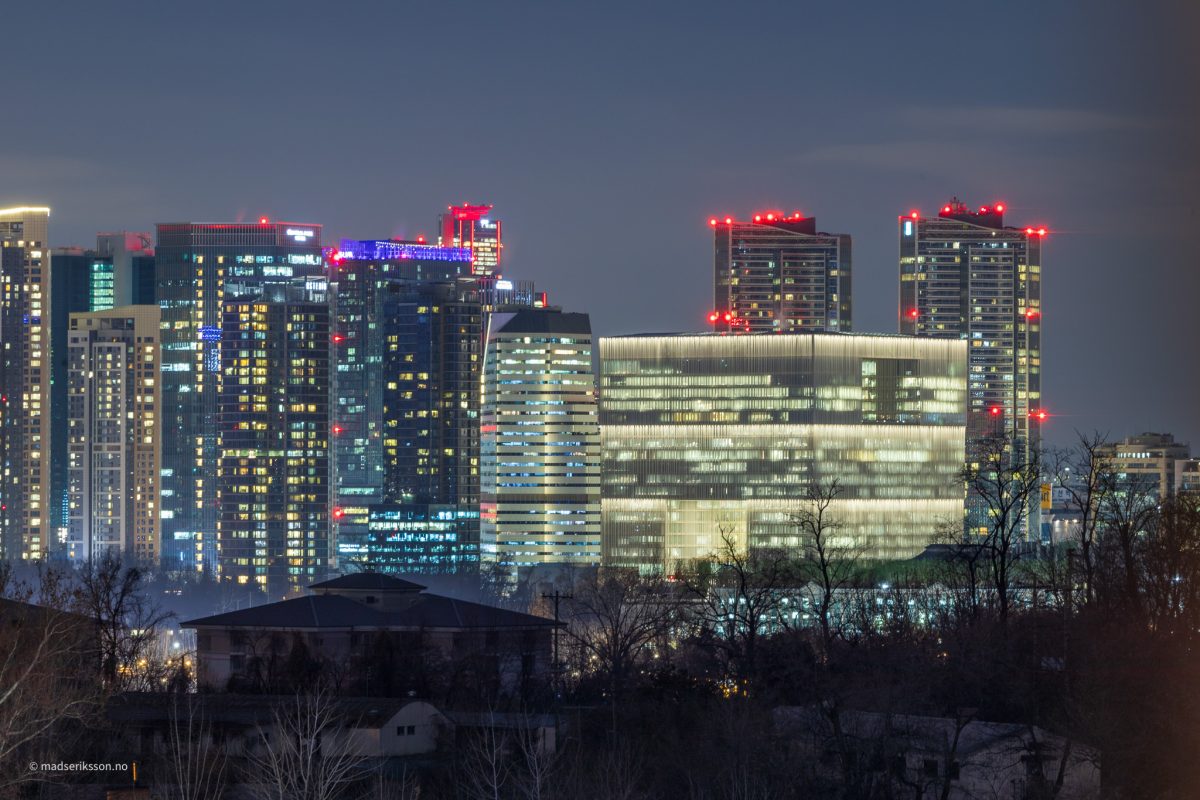
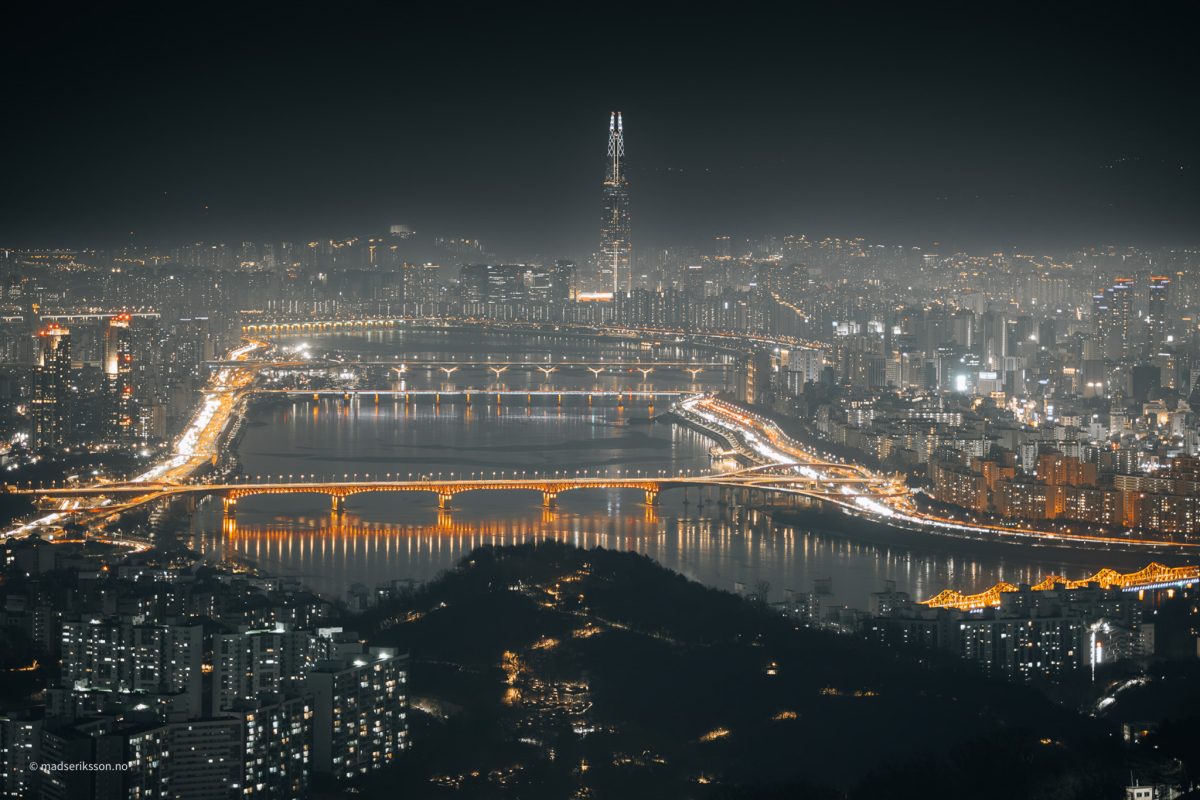
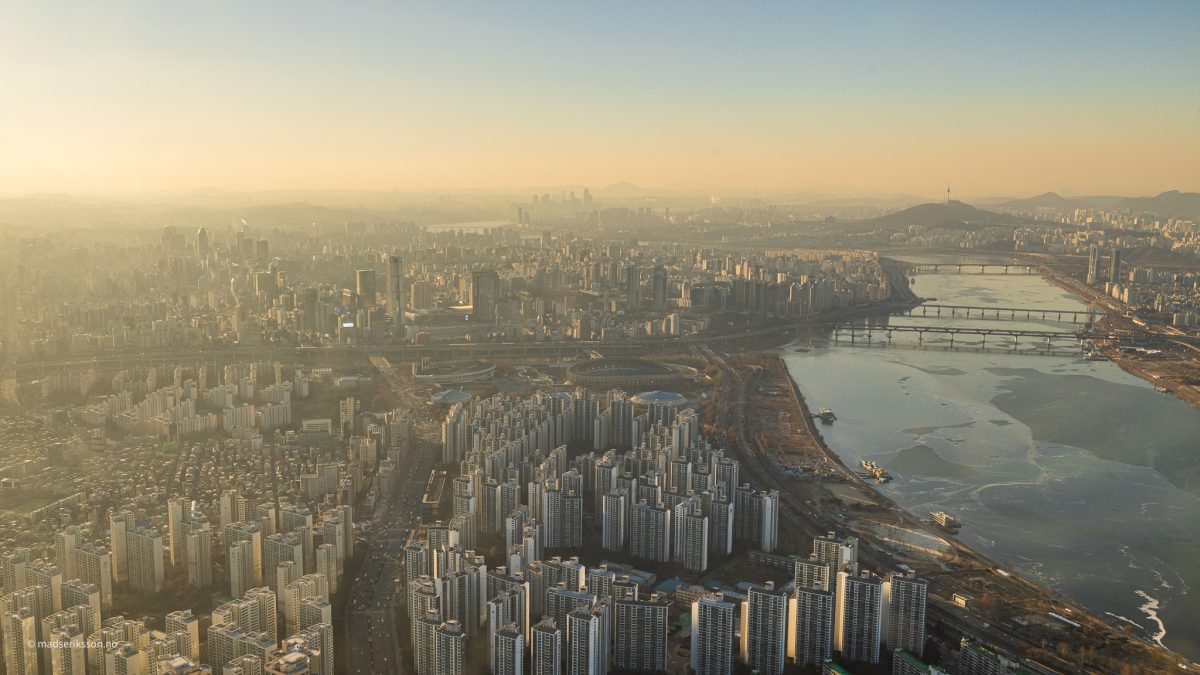
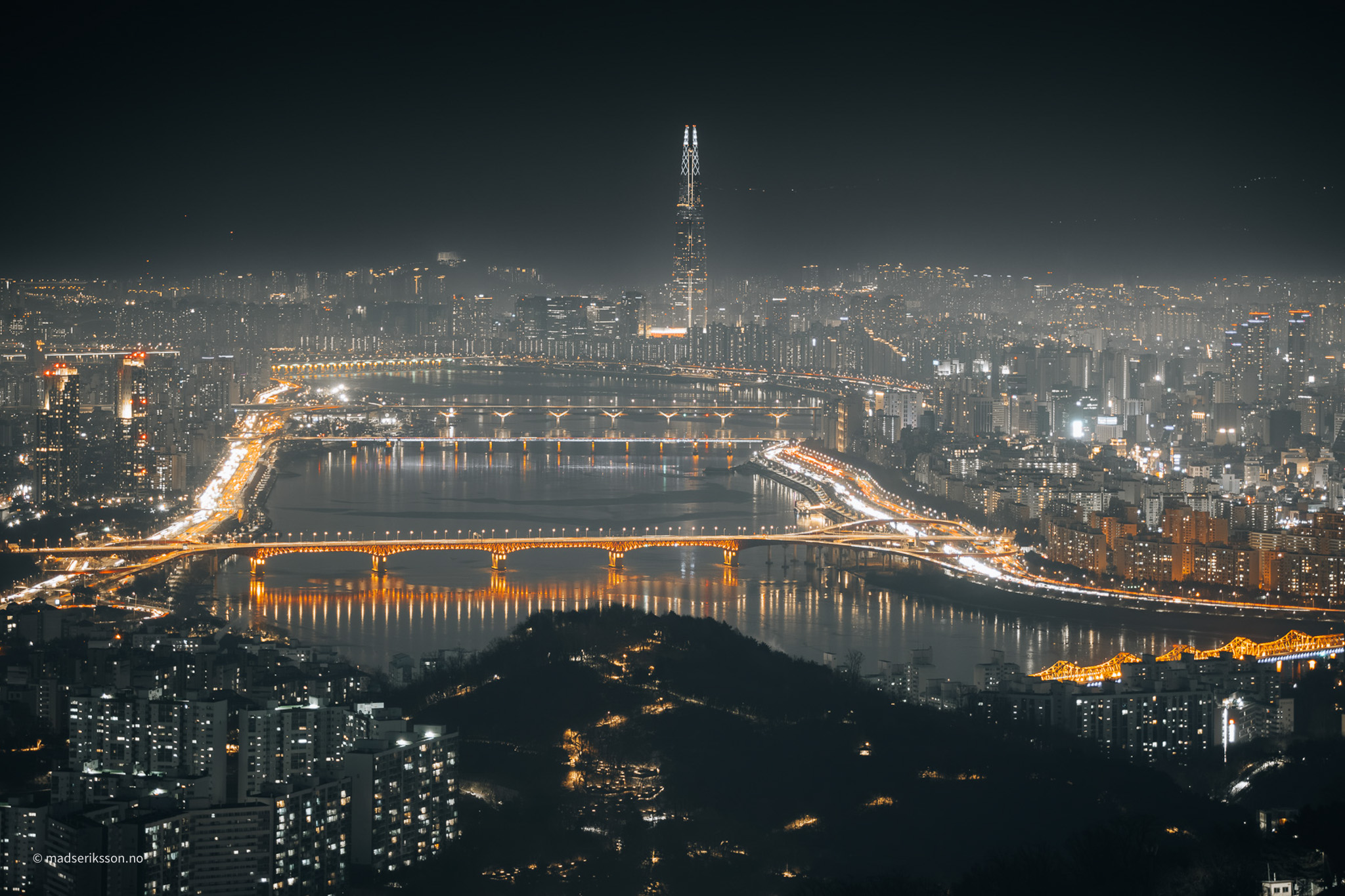
The Han River is close to a kilometre wide where it crosses Seoul, and more than twenty bridges span it. From high up it is the one feature that gives the city a shape: the towers and apartment blocks fill every flat piece of ground to the mountains, but the river cuts a clear band through the middle. In the night frame the river is black and the bridges are lines of light, with Lotte World Tower standing lit above the south bank. At 555 m and 123 floors it has been the tallest building in Korea since it opened in April 2017, and its Seoul Sky observation decks on floors 117–121 are where the dawn frames were taken.
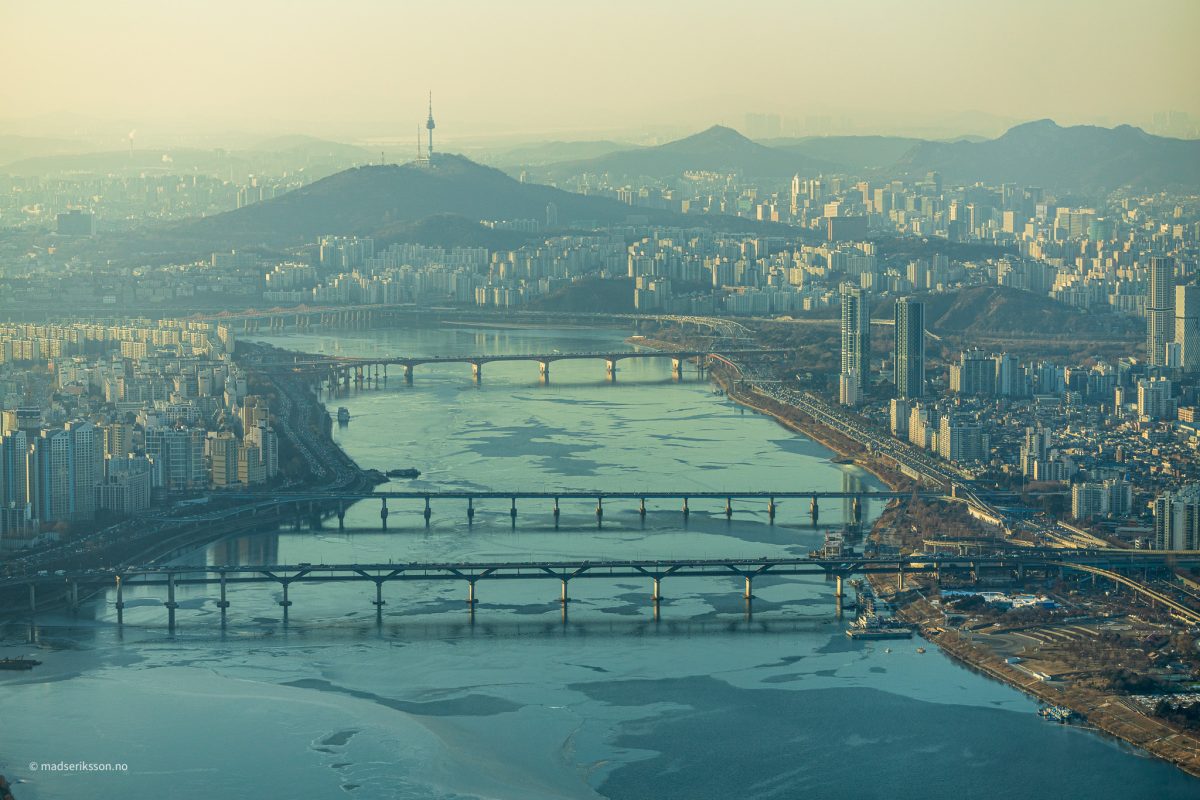
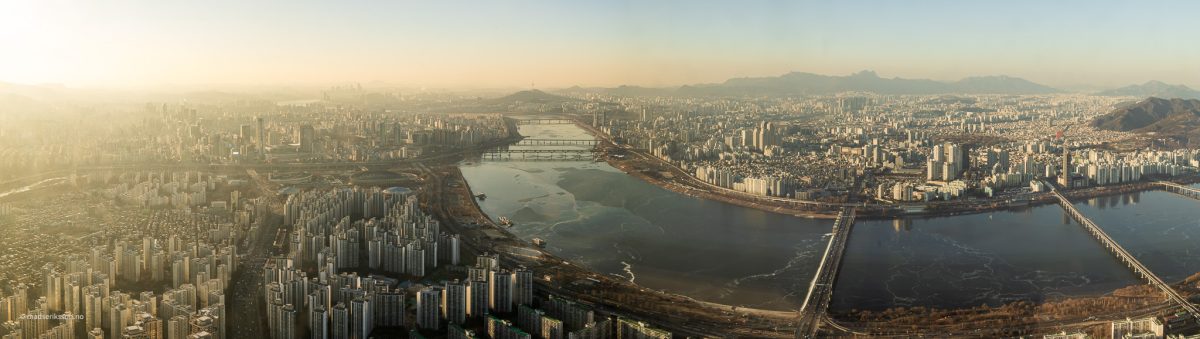
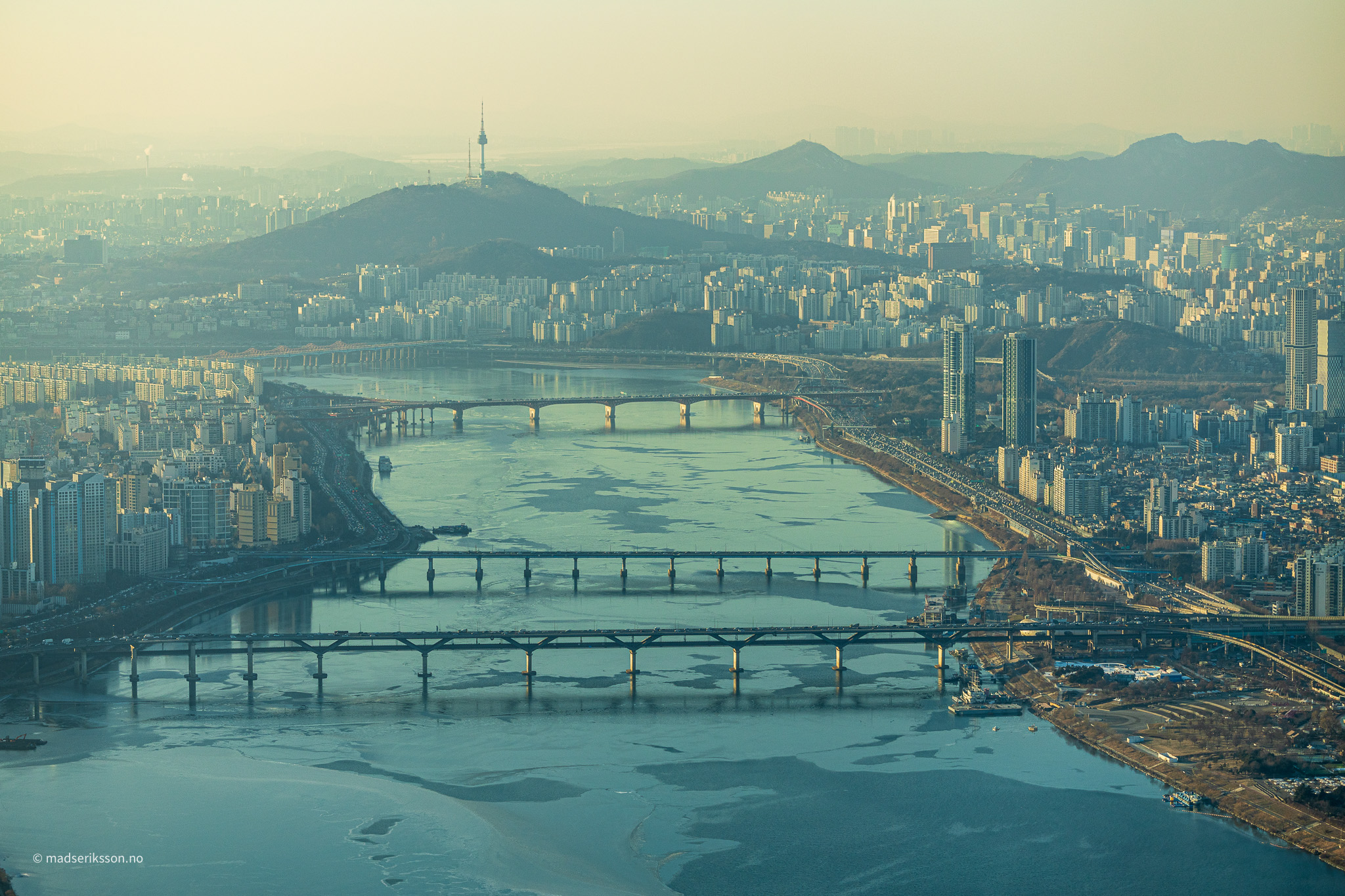
Those dawn pictures are hazy and almost monochrome. The river has frozen into pale sheets that stretch from bank to bank, the bridges stand dark across the ice, and in the distance N Seoul Tower on Namsan marks the old centre. A wide panorama takes in the river bending through the whole city in the first yellow light. In most years the Han freezes for a few weeks around the turn of the year.
«Seoul in winter is a city of hard light and warm steam. By day the sky over the palaces is a flat cold blue and the river lies frozen in sheets; by night the gates are floodlit, the avenues become rivers of headlights and the only warmth is in the market alleys, where the pancakes hit the griddle and the vapour rises into the bulbs. Thirty-eight frames, both banks of the Han, six hundred years of city.»
More in the same area
 CitiesSeoul: A Thriving Fusion of Tradition and Modernity
 CitiesGangnam, Seoul: Temples, Royal Tombs and the City South of the River
 Food and DrinksExploring Gwangjang Market: A Culinary Paradise in Seoul
 ArchitectureThe Breathtaking View from Lotte World Tower in Seoul
 ArchitectureDongdaemun Design Plaza: A Modern Architectural Marvel in Seoul
 ArchitectureTen Buildings That Changed Their Cities — Modern Architecture Ranked on Impact, Not Image